Disco back to 1970s Boston for ASP’s ‘Shrew’
By Rich Fahey
BOSTON — Not all of Shakespeare’s works have aged gracefully. A prime example is “The Taming of the Shrew,” which was written in the late 16th Century, and strong evidence exists that it was not only his first comedy, it was his first play.
Even by 16th Century standards, it demeaned women. As the centuries rolled by, it has been described as patriarchal, misogynistic, and portraying women as a commodity. And those are the good reviews.
Actors Shakespeare Project Artistic Director Christopher V. Edwards accepted the mission of dismembering, deconstructing and rebuilding the piece for the 21st Century, and his “Shrew” turns the story on its head, and the result is an exceptionally clever and creative production now at Suffolk University’s Modern Theatre through Oct. 1
The issue of the subjugation of women is still at the forefront, but this time it is the women doing the subjugating. The cast includes 10 women and one man, and the “Shrew” in question, Kate, is being played by the sole male, Michael Broadhurst.
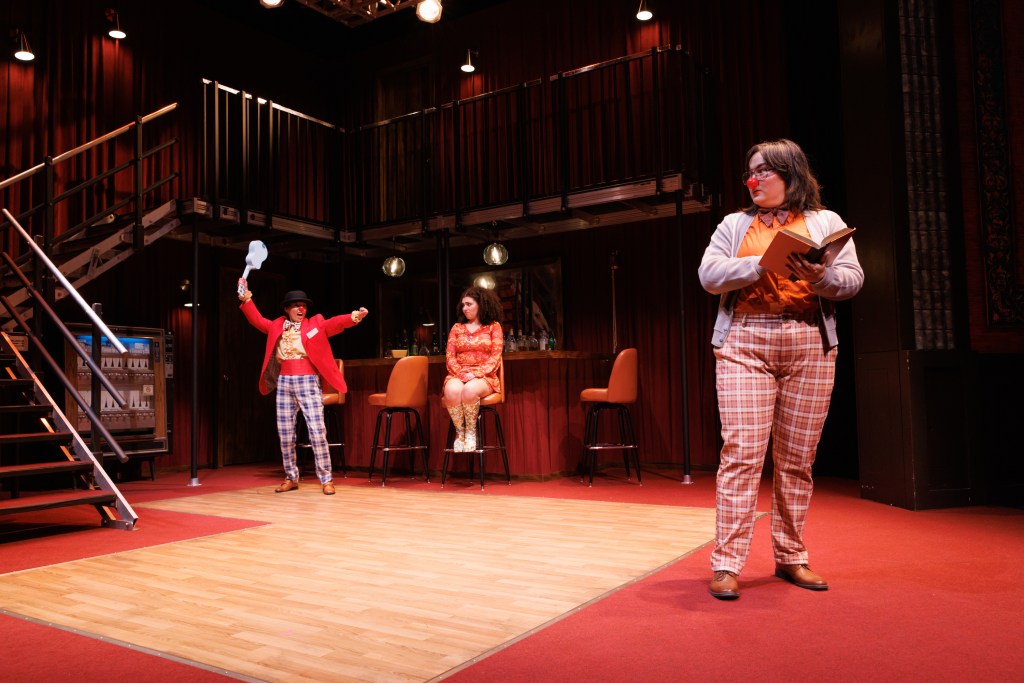
Set designer Ben Lieberman’s has set the piece in Bottom’s Dream, a 1970’s Boston disco bar complete with a disco ball.
Broadhurst also plays Christopher Sly, an ass and clown of a man who is trying to recover from a drunken night in said bar.
I can’t be sure, but this might be the first production of “Shrew” to feature both the Bee Gees and Labelle’s “Lady Marmalade,” both part of Elizabeth Cahill’s disco soundtrack.
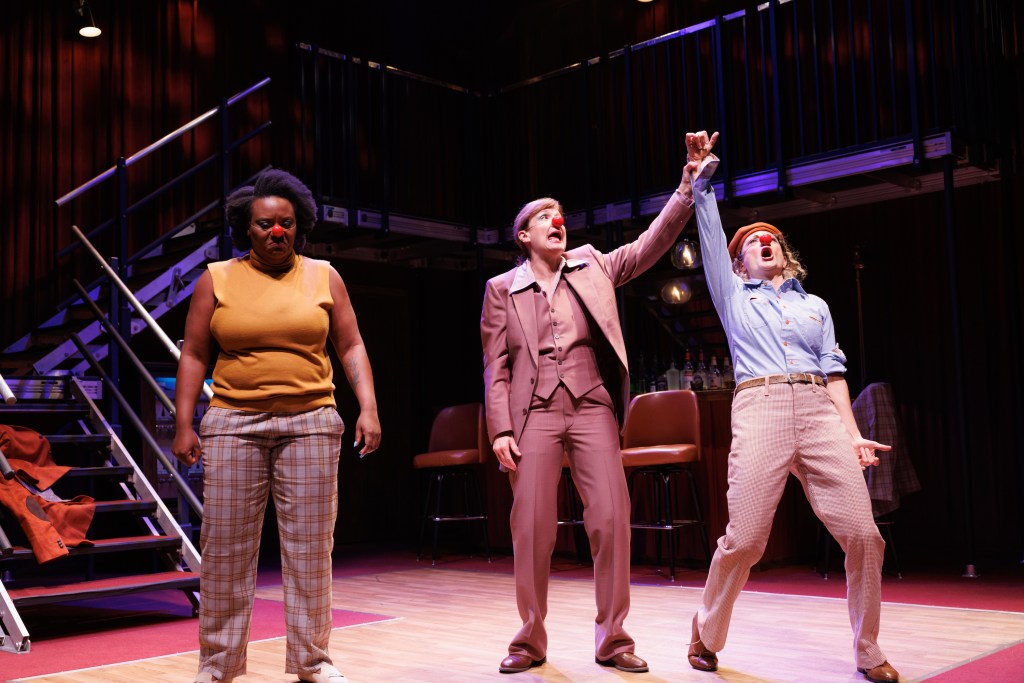
Chelsea Kerl’s costumes are straight out of the 70s, also firmly setting the time and place.
Edwards finds a clever way to make use of the so-called induction scenes from Shakespeare’s original play to get into his own vision. The story of Kate and Petruchio is a play within a play. Shakespeare’s version had a lord and his companions having some fun by finding a random drunk passed out in front of an alehouse, bringing him home, convincing him he is a nobleman and then entertaining with a comedy.
Edwards has Broadhurst as Sly passed out in the disco bar after a night of heavy drinking and meting out verbal abuse. A group of women conduct a rescue in which they bring him home, dress him up, and then conspire to convince him not only that he is a woman, but that he should be a character in their comedy. And not just any character, but Kate or Katharine, a central figure in the piece. And so, script in hand, he takes up the challenge.
Then the familiar story unfolds in which the student Lucentio (Paige Clark) arrives in Padua to further his studies, and learns that the merchant Baptista (Lisa Tucker) has two daughters. He is entranced by the pretty younger daughter, Bianca (Julia Hertzberg), and decides he must woo her. He finds the line to do that already long, including Gremio (Elena Toppo) and Hortensio (Kira Gandolfo), though Bianca favors neither.
He also learns that Bianca may not marry before the strong-willed older daughter Kate, who is, of course, played by Broadhurst.
Lucentio hears that Baptista will be hiring a tutor for Bianca and he poses as a Latin tutor to get closer to Bianca. It gets complicated when the elderly Gremio hires a disguised Lucentio to woo Bianca on his behalf, and Hortensio turns himself into a musician to get closer to her. Tranio (Joni Wesfeld), Lucentio’s servant, dresses as Lucentio to help sway Baptista in Lucentio’s favor. Even this early in his career, The Bard thrived on disguises and mistaken identities, which would become staples in his plays.
Michael Toomey is credited as the clowning consultant who juices up the proceedings, and red noses become the order of the day.
The fact that Edwards’ male characters are played by women enhances the comedic aspects of the piece as the women — led by Patrice Jean-Baptiste as Petruchio — go all out to and amplify the testosterone-fueled worst instincts of the characters. This Petruchio, for example, is cocksure, confident, strutting and preening, the very definition of of machoness and masculinity as he – lured by the possibility of wealth — comes forward to court older daughter Katharine, and sets out to “tame” her by any and all means available.
Baptista announces “Let’s Get Ready to Rumble” akin to a boxing match or a WWE wrestling match when the suitors begin serious competition for Bianca’s hand. Gremio and Lucentio are game-show contestants, one-upping each other in their claims of wealth and sexual prowess. It’s testosterone run hilariously amuck.
As far as the actual taming itself, Edwards and his cast cannot completely gloss over its darker aspects, but at least they are opening Sly/Katharine’s eyes to see what it means to be on the receiving end of such “taming” and hopefully shaming him for his past behavior.
Shakespeare feels right at home in the historic Modern Theatre. owned by Suffolk University and the cast seems to be having a great time. The fun can’t help spilling out into the audience. Edwards’ mission to deconstruct and rebuild the piece can safely be declared a hilarious success.
The Actors’ Shakespeare Project production of William Shakespeare’s “The Taming of the Shrew.” Through Oct. 1 at the Modern Theatre, 525 Washington St., Boston, actorsshakespeareproject.com.

Discover more from onbostonstages
Subscribe to get the latest posts sent to your email.