In ‘A Strange Loop,’ a human work in progress
By Rich Fahey
BOSTON – Years ago, Michael R. Jackson’s voice might never have been heard.
It may have been lost amid many other voices trying to be heard and recognized.
After all, a musical about a Black, queer writer trying to write a musical about a Black, queer writer does not – at first – seem like a likely path to a 2022 Tony Award for Best Musical and a 2020 Pulitzer Prize.
But talent eventually wins out. So one man’s journey away from self-loathing and finding a way out of “The Strange Loop” he finds himself confined in becomes a certified success, buoyed by Jackson’s ability to wring humor out of his character’s desperation and a corps of a disparate group of “Thoughts” who are a permanent part of his consciousness.
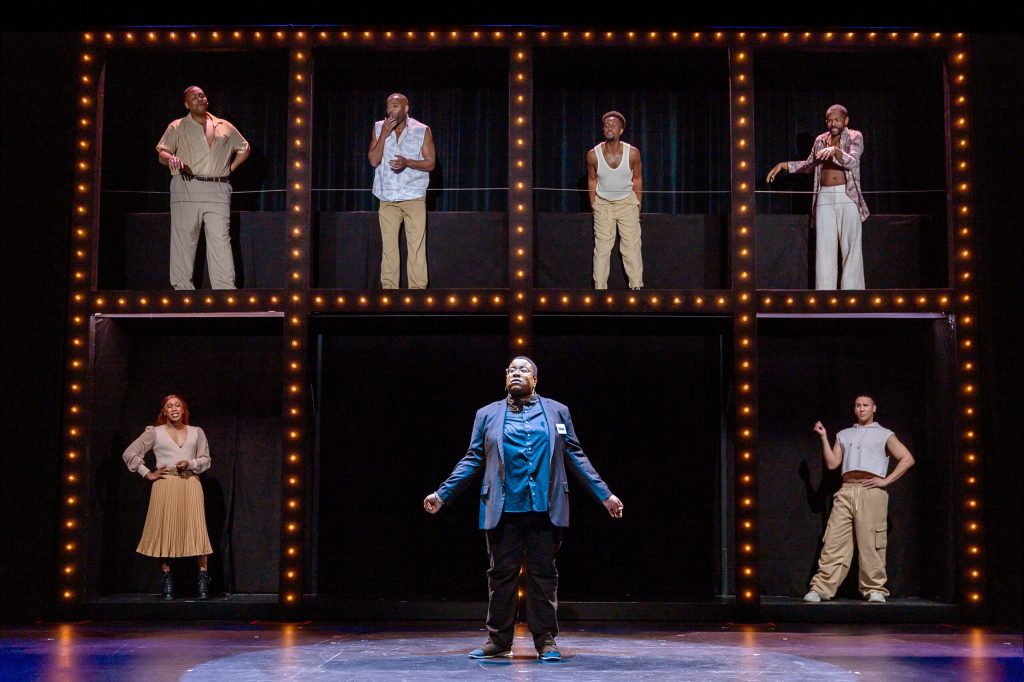
In “A Strange Loop,” a co-production of the SpeakEasy Stage Company and the Front Porch Arts Collective at the Calderwood Pavilion of the Boston Center for the Arts, Usher (Kai Clifton) is a 25-year-old usher at the Disney Broadway mega-hit “The Lion King.” There is symmetry in that; before it closed, “A Strange Loop” was being performed at the Lyceum Theatre, near the Minskoff Theatre where “The Lion King” reigns.
The \“Thoughts” – who often inhabit a two-tiered set of cubicles behind Usher – are hilariously and skillfully portrayed by Grant Evan, Davron S. Monroe, Jonathan Melo, Aaron Michael Ray, De’Lon Grant, and Zion Middleton. They inhabit a pantheon of characters and take turns telling Usher how he has fallen short in various aspects of his life, amplifying his assorted set of anxieties, and taking turns delivering punches to the gut.
While being an usher is what he is at the moment, he aims to be more – much more – than that. But Usher’s journey is not always for the faint-hearted. He is unhappy with his weight and online dating is a disaster, as his experiment with Grindr renders only despair. His pain is often expressed with generous use of the “N word” and there are simulated sex scenes – including a brutal assault involving a white man – that lower his already low self-esteem.
And there’s his family – don’t ask. He names his parents after “Lion King” characters; mother Sarabi is a God-fearing type but a walking pile of homophobia, urging Usher to stop running “up there in the homosexsh’alities” in favor of crafting a gospel musical Tyler Perry would love, Mufasa, his alcoholic father, poses disturbing questions about his son’s sexuality and warms Usher to abandon his lifestyle, lest he end up a victim of AIDS like his cousin.
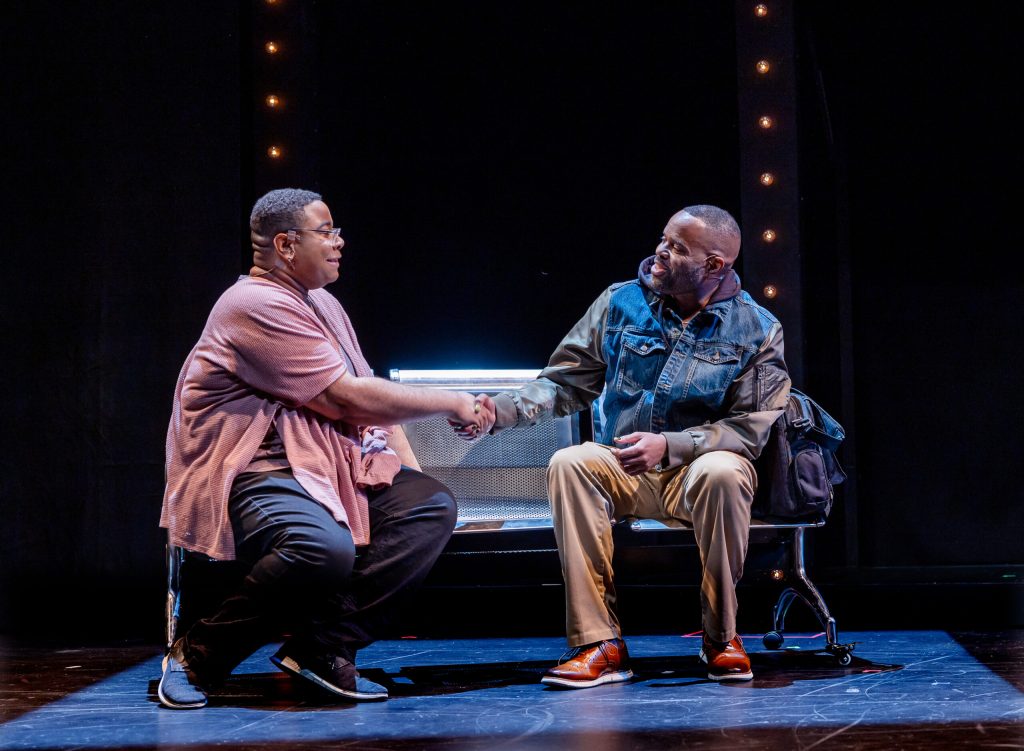
But when things get too tense or too downbeat, there is humor. Plenty of humor, such as the scene when the six Thoughts show up as Black icons from the past, including James Baldwin, Whitney Houston and Harriet Tubman, who have come back to life and assembled to tell Uher he is on the wrong path and to change his ways.
Director Maurice Emmanuel Parent, the director and co-producing artistic director of the Front Porch Arts Collective, has morphed almost seamlessly from being an acclaimed actor to a producer and director with equal acclaim. He has assembled a cast that is all in on both he and Jackson’s visions and have the necessary chops to put the ideas across.
In some important ways, Jackson’s piece is a traditional musical, despite the lack of a linear plotline. The endlessly creative songs, modeled after the work of Liz Phair, Tori Amos, and Joni Mitchell, a trio he describes as his “inner white girl” move the action along from the opening “Intermission Song” to the closing title tune, “A Strange Loop.”
And choreographer Taavon Gamble has the six Thoughts in constant movement in and around Usher, lecturing, hectoring, advising, scolding.
Playwright Jackson made it his mission to create a “big, Black and queer-ass American Broadway” show and he did just that, finding both critical success and an audience to hear his story along the way.
His story is moving, and though painful, told with both humor and heart. In the program notes, Paul Daigneault of Speakeasy Stage and Dawn M. Simmons of the Front Porch Arts Collective note that some who come to see “A Strange Loop” will be looking at a mirror; others will be looking through a window.
Either way, Jackson’s voice is heard and he opens the door for other voices to be heard.
During the course of the 100-muinute show performed without an intermission, the Thoughts take turns asking him how it will all end.
Thought No. 1 (Evan) asks “What’s ‘A Strange Loop’ about, who is it for and why does it need to be?” He urges Usher to clarify the script “so the audience knows when they can go home.”
Even with the closing number, “A Strange Loop,” there is no definitive ending, but we realize that Usher is just like the rest of us: He is a work in progress.
The SpeakEasy Stage Company and Front Porch Arts Collective Production of “A Strange Loop.” Book, music and lyrics by Michael R. Jackson. Directed by Maurice Emmanuel Parent. Music direction by David Freeman Coleman. Choreography by Taavon Gamble. Scenic design by Jon Savage. Costume design by Becca Jewett. Lighting design by Brian J. Lillenthal. Sound design by David Remedios. At the Calderwood Pavilion at the Boston Center for the Arts through May 25. More information: Speakeasystage.com or frontporcharts.com.
Discover more from onbostonstages
Subscribe to get the latest posts sent to your email.