‘Leopoldstadt’s’ power stuns Huntington audience
By Rich Fahey
BOSTON – The train was coming down the track. But there was no way – or was there? — that a Viennese family could foretell the wreckage it would cause.
In five chapters spread over 56 years, Tom Stoppard’s Tony Award-winning play “Leopoldstadt” — a stunning, powerful work now being presented by The Huntington and the Shakespeare Theatre Company at the Huntington Avenue Theatre — chronicles the antisemitism, the rise of the Third Reich and the eventual Holocaust that caused the decimation of a wealthy, prominent Jewish family.
It is widely seen as Stoppard’s most personal pay because it stemmed from his 1999 essay “On Turning Out to be Jewish.” Born in 1937 in Czechoslovakia as Tomas Straussler, he and his family emigrated to England when the German Army moved in. In the 1990s he learned that all four of his grandparents were Jewish and died in concentration camps, as did three of his mother’s sisters.
The rise of antisemitism in this country may have informed the timing of both this work and The Huntington’s production last year of Joshua’s Harmon’s “Prayer for the French Republic,” the story of antisemitism experienced by a Jewish family in Paris from 1944-1946 to 2016-2017. It went on to earn three Tony nominations on Broadway.
The productions link up in several ways, including actor Nael Nacer, who plays Herman Merz in “Leopoldstat” and earned his first Broadway credit for “French Republic.” Several other members of the “Leopoldstat” cast were also in “French Republic.”
Stoppard, 87, has often asked a lot from theater-goers, and “Leopoldstadt” is a sprawling piece that boasts 36 separate characters spread over several generations. To aid the audience in keeping everything straight, the program lists both the character and his/her relation to other characters while a graphic in the program details the Merz-Jacokovicz family tree.
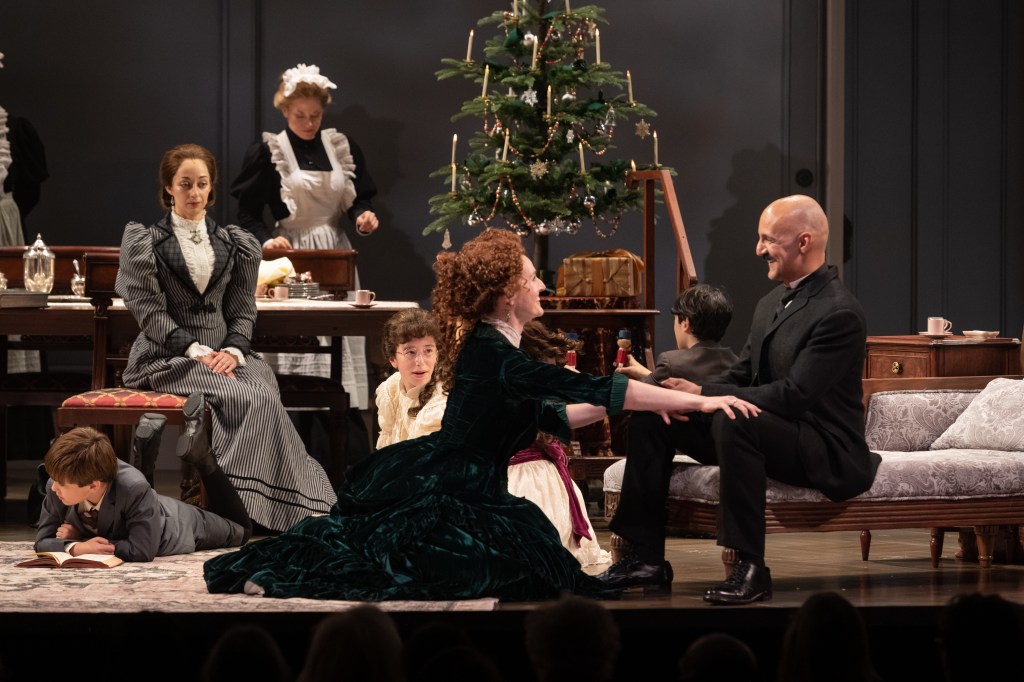
In the first chapter set in 1899, the extended family is enjoying a holiday gathering in the drawing room of the family apartment, where matriarch Emilia Merz (Phyllis Kay) presides. Because Hermann (Nael Nacer) has converted to Catholicism in marrying Gretl (Brenda Meaney), a gentile, a child adorns the Christmas tree with a Star of David, reflecting the two religions.
The discussion turns to whether Jews have assimilated and earned the respect of other Viennese for their accomplishments in medicine, science, and the arts, and whether they have finally assimilated and insulated themselves from antisemitism.
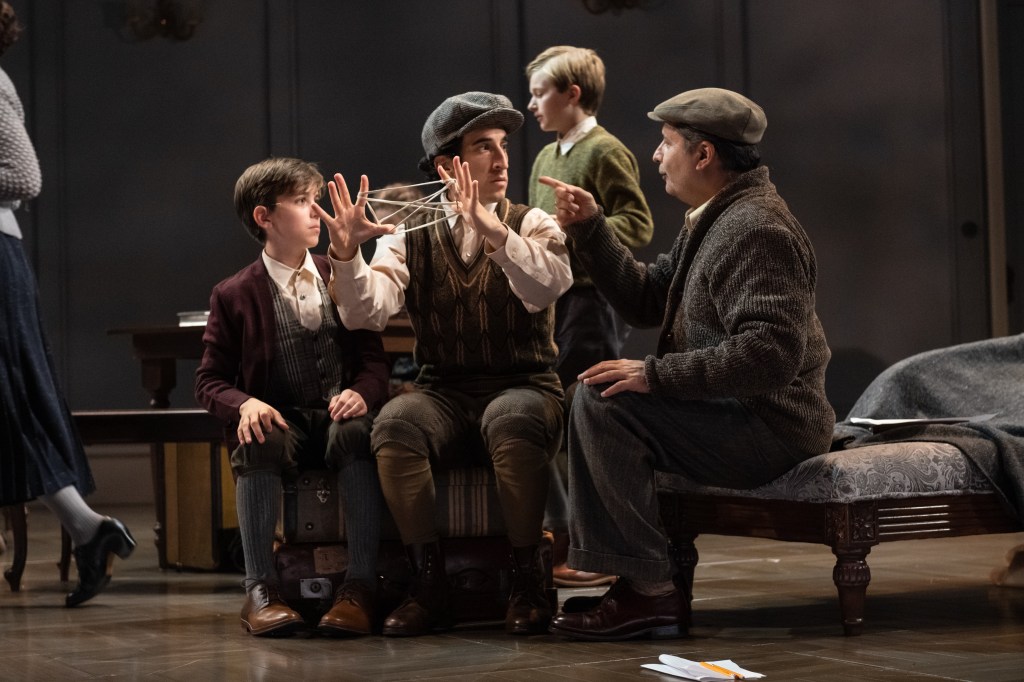
While Hermann insists that “We are all Austrians” now, mathematician Ludwig (Firtous Bamji), married to Hermann’s sister Eva (Rachel Felstein), is skeptical, citing several instances of lingering antisemitism.
In 1900, an affair between Gretl and a soldier named Fritz (Samuel Adams) finally ends, and while Hermann discovers infidelity, he does not act on it.
The action shifts to 1924 and the fallout of World War I. Hermann and Gretl’s son Jacob (Mishka Yarovoy) has been gravely injured and his cousin Pauli, Ludwig and Eva’s son, killed in the war. Hermann, sensing what is to come, makes a decision about the future of the family textile business.
In 1938, the family’s worst fears are realized, and the train that has been coming down the tracks arrives with full force. It is the anti-Jew pogrom Kristallnacht, the Night of the Broken Glass, and a heartless Nazi operative (Samuel Douglas) abuses and then evicts the family members from their home, sending them off to the city’s Jewish ghetto, Leopoldstadt. It is a harrowing, bone-chilling scene because we know what fate awaits almost all of them.
Director Carey Perloff, a playwright and a longtime interpreter of Stoppard’s work, is a daughter of Jewish Viennese refugees; her personal interest in the piece informs every decision she has made.
The production values are simply sublime, in keeping with The Huntington’s customary attention to detail. That includes Ken MacDonald’s exquisitely detailed drawing room, where most of the action takes place and Adam Jaeger’s costume design, period perfect as the action moves forward.
The lighting by Robert Wierzel in concert with the sound design and original music by Jane Shaw capture the darkness of the mood and set the tone as the events play out. Yuki Izumihara’s projections graphically depict events such as the Kristallnacht, and Jews being led off to their deaths.
In the wrenching last scene of the play, in 1955, three surviving members of the family return to Austria. They include Leo (Miska Yarovoy) , who had come to Britain as a child, assimilated and is seen as a stand-in for Stoppard himself. Leo has no memory of life as a Jew in Vienna. Rosa (Rebecca Gibel), who left for New York before the Holocaust, is also there as is Nathan (Joshua Chessin-Yudin), who survived Auschwitz. Together, they look back in horror – just as Stoppard finally did.
In the 30 years I have been covering shows at the Huntington Avenue Theatre it was the first time I recall a scene that left an audience so stunned and silent that you could literally hear a pin drop.
Yes, “Leopoldstadt” may be unwieldy in its construction and challenging in the many characters who will come and go through the years, but it is a theatrical event that will be seared into your memory bank and linger there long after the final curtain.
The Huntington in association with Shakespeare Theatre Company production of “Leopoldstadt.” Play by Tom Stoppard. Directed by Carey Perloff. At the Huntington Theatre, Boston. Through Oct. 13. Tickets start at $29. 617-266-0800, huningtontheatre.org
Discover more from onbostonstages
Subscribe to get the latest posts sent to your email.