‘Back to the Future’ is a theatrical thrill ride
By Rich Fahey
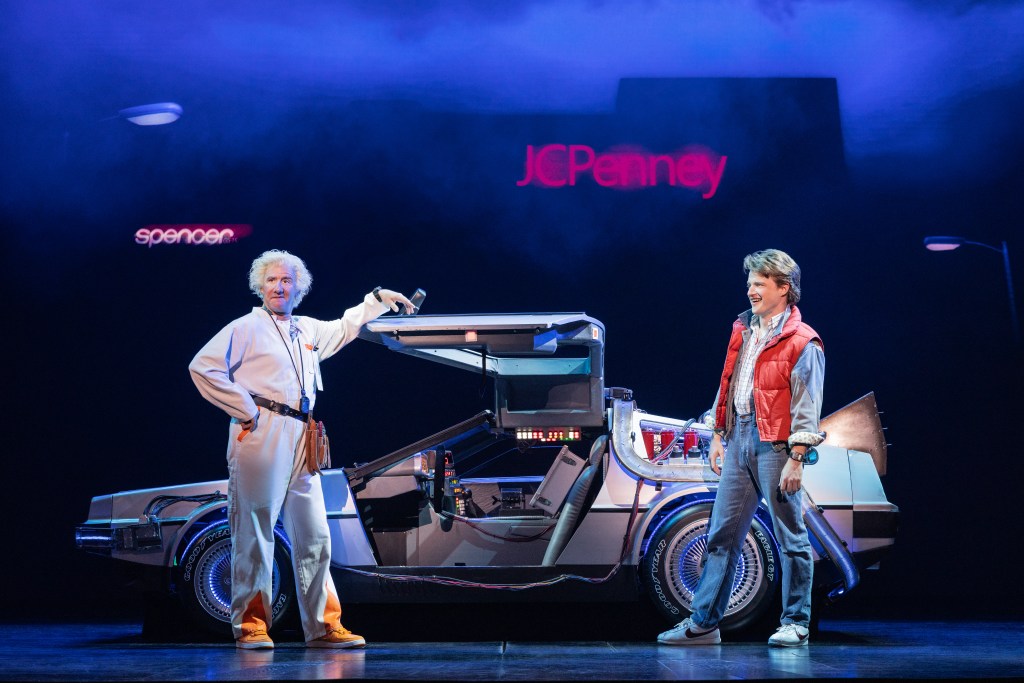
BOSTON – Let’s get it straight right away. The national touring production “Back to the Future: The Musical” is a theatrical thrill ride of the first order, a series of gee-whiz, how-did-they-do-that moments that start with the first appearance of the iconic DeLorean on the stage of the Citizens Bank Opera House.
The fans of the first of three “Back to the Future” movies directed by Robert Zemeckis in 1985 will note that the musical’s plot aligns closely to the plot of the movie, co-written by Zemeckis and Bob Gale, with Gale penning the adaptation for the musical.
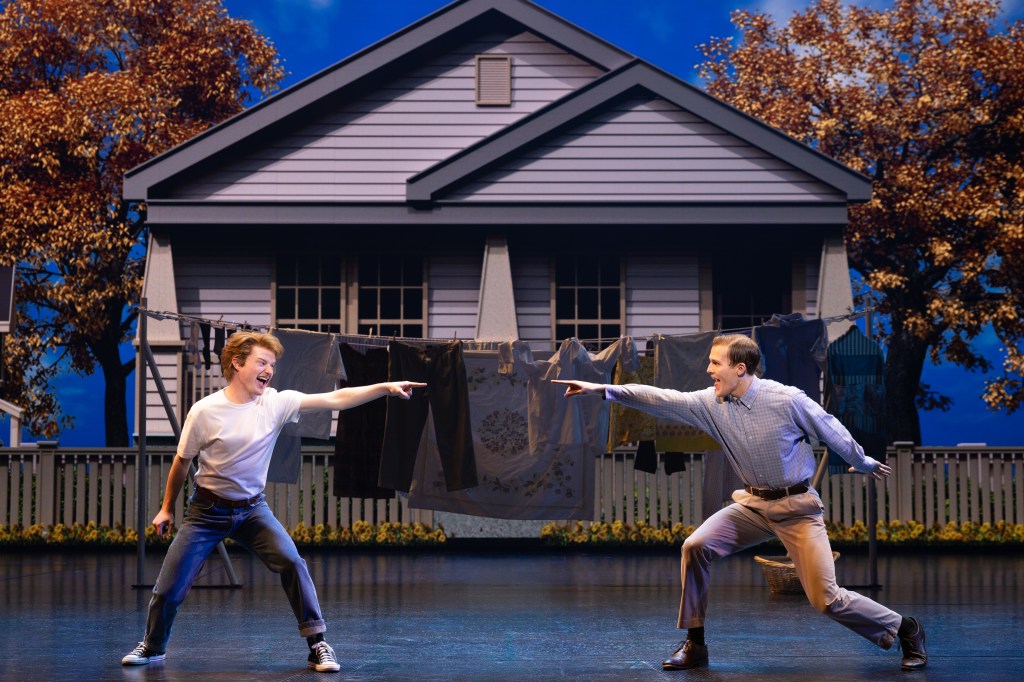
The musical’s twin settings of 1985 and 1955 allow the designers to wring every bit of humor they can in depicting the two very different eras. The production benefits from some high energy performances, other-worldly lighting and sound, state-of-the-art projections and illusions that allow the climactic scene of the DeLorean’s perilous return to 1985 to be reenacted in its full glory.
17-year-old Marty McFly (Lucas Hallauer) accidentally goes back in time 30 years to 1955 in his hometown of Hill Valley, where he tries to get to the bottom of why his father George (Mike Bindeman) is a spineless sort, tormented in both 1955 and 1985 by a relentless bully named Biff Tannen (Nathaniel Hackmann). Biff also finds time to harass Marty when he goes back to 1955. Gale’s book reprises some very sticky sequences from the movie, including scenes when Marty, in 1955, is forced to fend off some very aggressive advances from his own future mother, the then Lorraine Baines (Zan Berube).
The show is a bit slow to take off, especially in the first half hour when we meet the McFly family, a collection of rudderless losers. Marty would like to escape the label of “slacker” by becoming a rock star, with the help of girlfriend Jennifer (Sophia Yacap), whose uncle is a record producer. Hallauer captures the essence of the character created by Michael J. Fox, a frustrated Everyman striving for better things, and his vocal instrument sets the pace for the rest of the cast.
It isn’t until the appearance of erratic scientist Doc Brown (David Josefsberg) and the DeLorean that things start to take off. Josefberg’s Doc Brown isn’t quite as over-the-top as Christoper Lloyd in the film or Roger Bart on Broadway, but he goes do full justice to his vocal opportunities, especially the lovely “For the Dreamers.” It’s a tribute to those who persisted and accomplished great things and also describes his hopes for his and Marty’s futures. Josefsberg is also the centerpiece of several extravagant production numbers courtesy of Chris Bailey’s choreography, and he is accompanied by an energetic ensemble in the Act II opener “21st Century.” Bailey’s ensemble moves from 1955’s jitterbug and lindy hop to styles such as 1985’s Michael Jackson moonwalk.
Of course, Marty is a fish out of water in 1955,with his 1980s-style down vest that everyone believes is a life preserver. We also have the unwanted presence of the so-called space-time continuum, a familiar concept in time-travel works, which means things Marty does while he is in 1955 could affect the future existence of both himself and his siblings. That means there is urgency for Marty to fend off his future mother’s advances and make sure George and Lorraine connect, and Marty gets his one chance to return to 1985.
There is also a fine supporting turn by Cartreze Tucker as Goldie Wilson, an upbeat restaurant worker who dreams great dreams and realizes them.
Director John Rando keeps the pace lively; for the Boston run; a few locally-based moments of humor have been inserted, usually centering on our very distinctive manner of speaking.
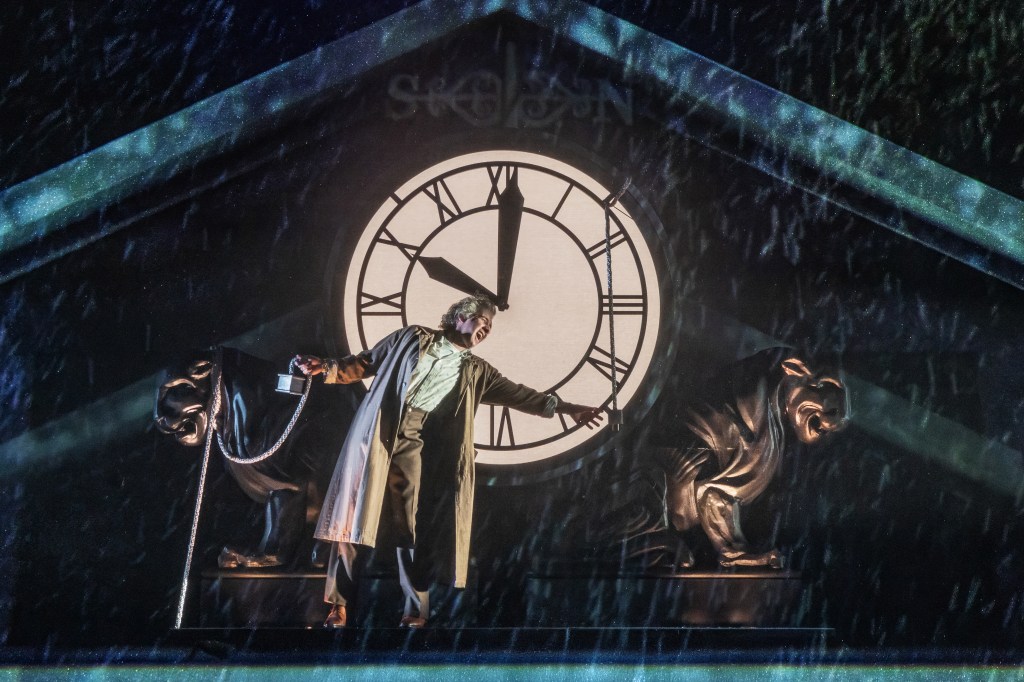
Ah, the big scene you all came to see. The stolen plutonium used to set the DeLorean in motion in the beginning was used up while sending Marty back in time, and his only chance to return is a lightning strike at a precise moment – necessitating coordination with the clock high above the town square. Miss it and he is forever trapped in 1955.
Cue Josefberg’s Doc Bown’s daring high-wire act to attract lightning to the DeLorean, It is a superb combination of acting and special effects that had the audience up and cheering. It appeared that many of the theater-goers had seen the movie way more than once.
The score by Alan Silvestri and Glen Ballard does have pleasant moments, but never really blasts off like the DeLorean and the flux capacitor that enables time travel. The music side is boosted by the inclusion of 1950s numbers such as “Johnny B Good,” which allow Hillauer to reprise Marty’s epic guitar solo, and from the film1980s “The Power of Love” by Huey Newton.
Kudos to all of the design team across the board, including sound designer Gareth Owen, lighting designers Tim Lutkin and Hugh Vanstone, video designer Finn Ross, illusion designer Chris Fisher, designer Tim Hatley, and all the others who made this production such a treat for the eyes and ears.
Onstage, and as a musical, “Back to the Future” remains a wild ride, and the producers have wisely chosen not to stray too far from the highest-grossing movie of 1985. Hopefulness, the theme of the movie, is still the order of the day. Welcome back, Marty and Doc.
The national touring production of “Back to the Future: The Musica.”. Presented by Broadway in Boston at the Citizens Bank Opera House Through Sunday, July 20. BroadwayinBoston.com
Discover more from onbostonstages
Subscribe to get the latest posts sent to your email.