Huntington’s ‘Hills of California’ sets the bar high
By Rich Fahey
BOSTON – Regret, I’ve heard it said, is the cancer of life. And the effects of guilt that festers for years can be toxic and, in the end, deadly.
In an upstairs bedroom of a tired guest house in Blackpool, England, a woman named Veronica Webb is dying painfully from stomach cancer in the summer of 1976. On the first floor, three of her four daughters wait for the arrival of the fourth daughter flying in from California. The arrival is expected to set off a bomb that has been ticking since May 1955.
In The Huntington’s superb production of Jez Butterworth’s “The Hills of California,” the daughter will eventually arrive and the events of 1955 will have to be dealt with.
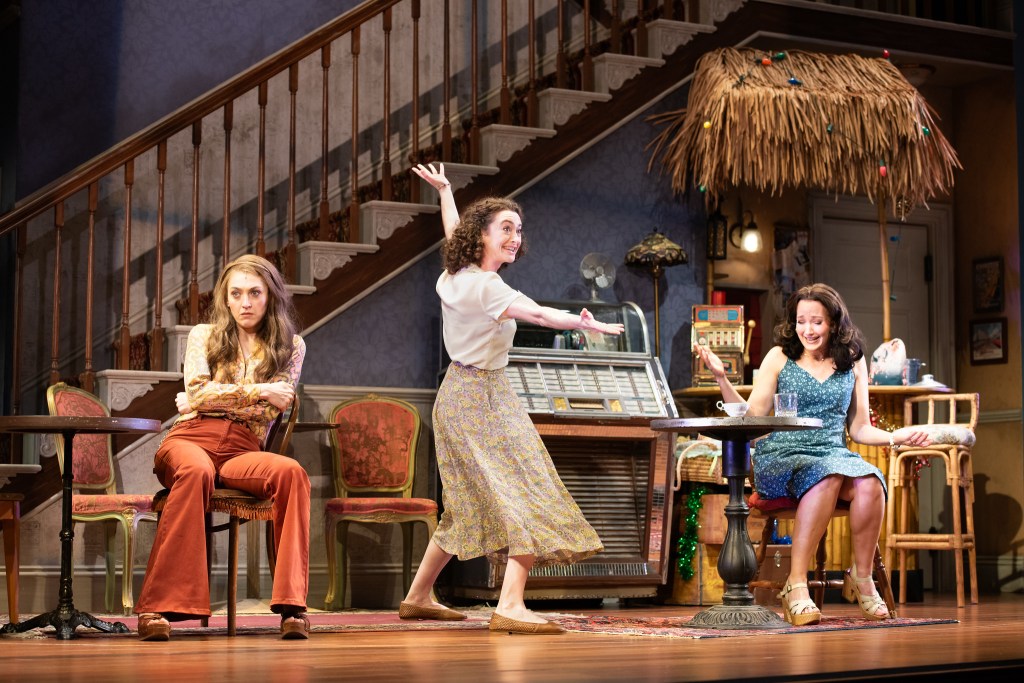
Butterworth tells the tale with two excellent casts. In 1976, three daughters in their 30’s reunite: Jillian (Karen Killian), the youngest, who has become a very nervous caretaker for the deathly ill mother; Ruby, (Aimee Doherty) more upbeat by nature; and Gloria (Amanda Kristin Nichols), still embittered over what happened years before. They gather in the guest house after a nurse informs Jillian her mother is in her final hours.
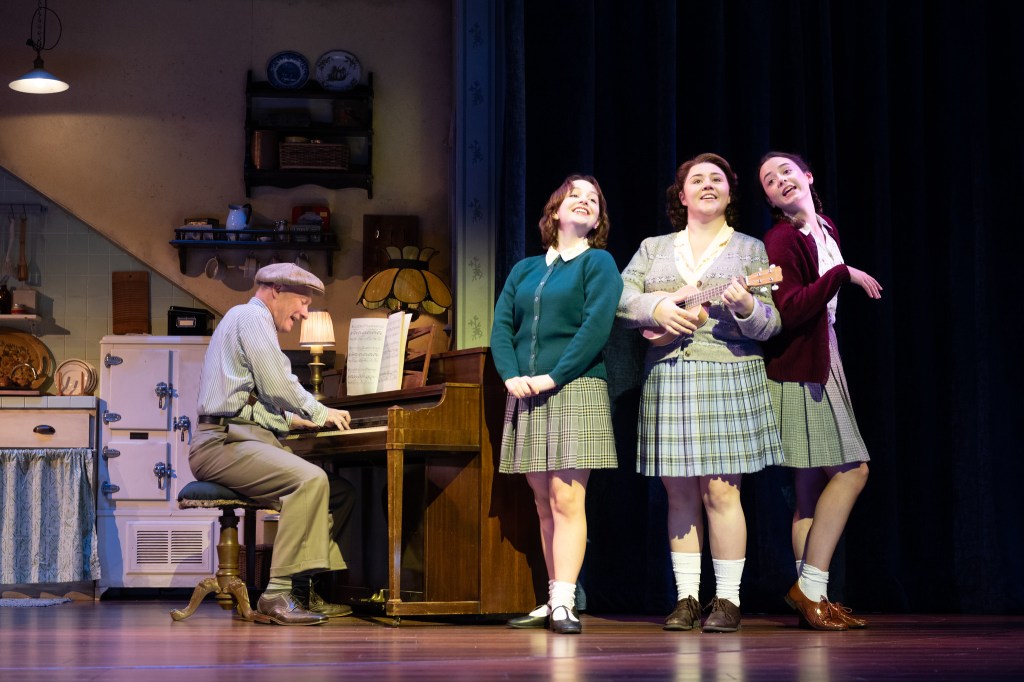
Allison Jean White brilliantly anchors both the 1955 and 1976 casts. In 1955, she is Veronica Webb, the struggling widowed mother of four daughters who runs the guest house. The daughters are 12-year-old Jillian (Nicole Mulready); 13-year-old Ruby (Chloe Kolbenheyer); 14-year-old Gloria (Meghan Carey); and 15-year-old Joan (Kate Fitzgerald).
In 1976, she is the adult Joan, the daughter returning after a long absence, an absence that is at the heart of the piece.
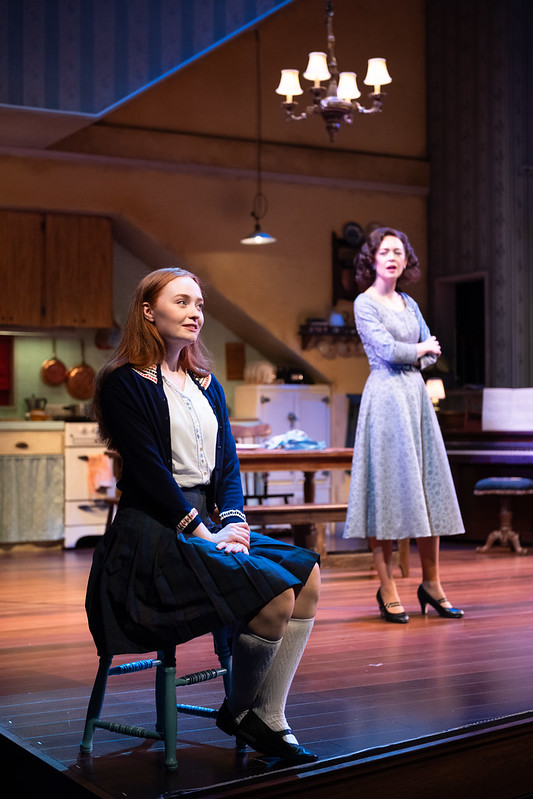
The play opens in the summer of 1976 before moving back to May of 1955 and then back again, and the setting in both cases is the rooms of the guest house that have grown shabbier and shabbier. The Seaview has had many different names, but one thing is constant: You can’t actually see the ocean from anywhere in the house.
One of the constants in both years is a piano in the corner of the room; it has just been tuned as the play opens, and both casts will have a chance to strut their stuff as vocalists.
In 1955 Veronica, widowed at a young age under murky circumstances, has molded – many would say forcefully — her four daughters into a cohesive young vocal quartet, performing in harmony such period classics as “Boogie-Woogie Bugle Boy,” “It Never Entered My Mind,” “When I Fall in Love” and “Dream a Little Dream of Me.” As they channel the Andrews Sisters, they are unaware the group has all but disappeared by then. Still, Veronica dreams of a singing trio, and at one point muses “I even have a spare.” That “spare” is Gloria, and the adult Gloria, embittered, will not forget.
It takes no great leap to connect to Mama Rose in “Gypsy,” living her life through her children and going to any lengths to improve the family’s lot in life.
There is a moment in the play that connects 1955 and 1976 in a very powerful way. Jack Larkin (Kyle Cameron), one of Veronica’s boarders, is a street busker who survives on handouts from tourists. Inexplicably, it turns out he has a connection in the music business. He sets up an audition for the girls with noted producer Luther St. John (Lewis D.. Wheeler).
St. John shows up and realizes quickly that Veronica is stuck in the past, unaware of Elvis Presley or that rock and roll is taking over the world.
After listening to the girls perform their signature tune – the Andrews Sisters’ “Boogie Woogie Bugle Boy” – he asks Veronica if Joan can audition for him in one of the guest house’s private rooms. Veronica is very hesitant, but when Joan agrees, she and St. John head upstairs. It is a decision to regret, and guilt will haunt Veronica to the end of her days.
White as Veronica is radiant as she listens to Joan sing the heartbreaking “When I Fall in Love,” a moment when it seems possible Veronica’s dreams for her children will all come true. Suddenly, Joan stops, and the silence brings a sense of dread that will ring through the years, until Joan finally arrives back in Blackpool in 1976.
Huntington Artistic Director Loretta Greco, who directed this production, not only cast adroitly but has also employed a number of designers who have helped make the production so ascendant. It all starts with the stunning, towering three-story rotating set of the guest house designed by Andrew Boyce and Se Hyun Oh that generated sustained applause after the curtain was raised at a recent performance. It rotates quickly as the actions moves between the 1955 and 1976 sets.
Through the years, The Huntington has earned a reputation for stunning production values, and in this case Boyce and Oh share the stage with lighting designer Russell H. Champa, sound designer and composer David Van Tiegem, and costume designer Jennifer von Mayrhauser.
In program notes Greco, as one of five daughters who gathered in their childhood home to observe the passing of their father, noted how the play’s themes resonated so strongly with her and informed her work.
“The Hills of California” sets a high, high bar for the rest of The Huntington’s season to match.
“The Hills of California.” Play by Jez Butterworth. Directed by Loretta Greco. Production by The Huntington in association with Berkeley Repertory Theatre. At Huntington Theatre, Through Oct. 12. Huntingtontheatre.org
Discover more from onbostonstages
Subscribe to get the latest posts sent to your email.