CST’s ‘Summer, 1976’ is a series of small pleasures

By Rich Fahey
CAMBRIDGE – Often, the children hold the key.
They make friends in school, on the playground, on the soccer or softball field or while bouncing around in a kiddie pool.
After young Holly and Gretchen find each other, they can’t be broken apart, and soon their mothers are also a pair in David Auburn’s poignant memory play “Summer, 1976,” which begins in the bicentennial year and evolves over 27 years.
The play, by Auburn, a Pulitzer Prize winner for “Proof,” unfolds as a series of small pleasures, thanks to superb performances by Laura Latreille and Lee Mikeska Gardner, and en pointe direction by Paula Plum.
“Summer, 1976” takes place largely in the college town of Columbus, Ohio, where two disparate women strike an unlikely chord, tenuous though it seems from the get-go. Diana (Gardner), a single mother and an artist who also teaches, early on breaks down the fourth wall, confiding in the audience, describing Alice (Latreille) as “a sleepy-eyed little hippie with her shorts and her coconut oil.”
Diana is also not shy about admitting “I sort of immediately hated her,” and she’s not that wild about Alice’s daughter Holly, either. “I didn’t like her child, actually.”
Alice, meanwhile, is a free-spirited stay-at-home mom with no interest in cooking, cleaning and decorating. Alice’s reading choices that summer included popular titles such as “Shogun” and “Coma,” allowing Diana to look down her nose at her, with Alice feeling free to label Diana “a snob.” Diana doesn’t let her daughter watch anything on TV other than PBS, and her family money means she doesn’t have the financial worries Alice does.
There are many dueling monologues – Auburn uses several theatrical devices to tell the story — as the women look back on the events that brought them together, and helped them to drift apart.
Soon after meeting, as their children play together, bouncing around in a kiddie pool, Alice offers a joint and Diana, making a point because she knows how Alice thinks about her, takes a huge toke. And a friendship begins to take shape.
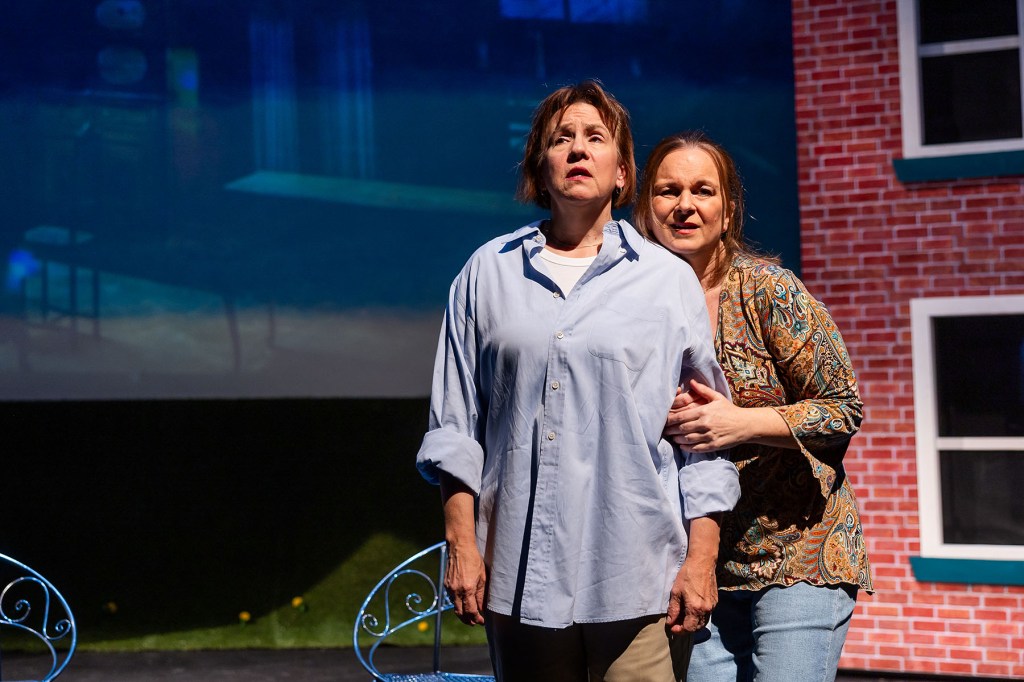
We learn that Diana became pregnant in art school during a short fling with a glassblower; Alice, meanwhile, dropped out of graduate school to get married, then had Holly. A staid midwestern college town like Columbus was never what they hoped for.
There is plenty of humor to be had that summer. Alice’s unseen economist husband Doug, largely absent because he’s hot on the tenure trail at Ohio State, is portrayed by Diana in several scenes, and a recurring bit involves the baby-sitting system he designed with local couples trading “shares” back and forth to cover for each other; it is actually how Diana and Alice met. It eventually implodes when Alice and Diana decide to create their own shares, causing Doug to howl the economist’s dreaded word: “Inflation!”
There are also the bawdy moments when the grad student hired to paint Alice’s house that summer spends a large amount of time ogling her skimpy outfit and then disappearing to the bathroom.
They find their way into the other’s home, despite Diana’s disdain for Alice’s lack of homemaking skills. There is a fraught moment when Alice goes out of her way to praise Diana’s art, only to be told they are all “unfinished.” But as the friendship strengthens, the oft-dislikeable Diana surprises us; we find she has a powerful reserve of compassion when Alice’s family dynamics go awry.
Plum, in her previous directorial efforts, has made it a point not to let the actors rush past small but important moments, especially here as the women’s divide grows larger through the years. It is no surprise that Plum, working with two very experienced actors and another excellent director in Gardner, found the common ground needed.
The children, who at the beginning played an outsized part in bringing their mothers together, will grow and Holly and Gretchen will go their separate ways from their mothers, and the joys and disappointments their daughters experience will be another factor in Diana and Alice drifting apart. There will be regrets from both women over the trajectory of their friendship and how it might have been different.
The designers complement the playwright’s vision; costume designer Sydney Hovasse offers a stark contrast with a paisley top for free-wheeling Alice, and a button-down shirt and khakis for the more reserved Diana.
Scenic designer Kristin Leoffler offers two very distinct homes for the women and there are vivid projections by Justin LaHue, including a cross-country trip to San Francisco and a dazzling fireworks display; Deb Sullivan lights a succession of summer sunny days.
After the curtain, Gardner, who first came to Boston in 2014 and quickly became a force on stage, directing, and as the artistic director of first the Nora Theater and then the Central Square Theater, addressed the audience. She reminded them that, given the political landscape and with several sources of funding drying up, the existence of live theater is no longer a given. She urged the audience to be mindful of that.
The Central Square Theater production of “Summer, 1976.” Written by David Auburn. Directed by Paula Plum. At the Central Square Theater through Nov. 30. Centralsquaretheater.org
Discover more from onbostonstages
Subscribe to get the latest posts sent to your email.