Huntington’s ‘Prayer’ has heart, humor and humanity
By Rich Fahey
BOSTON – At the beginning and end of Joshua Harmon’s superb intergenerational drama “Prayer for the French Republic” at The Huntington, the stirring French national anthem “La Marseillaise” can be heard.
It signals the beginning and the end of a raging debate that his characters will have for the entire 170 minutes of the production.
It all takes place in a Paris apartment amid growing antisemitism in Paris in 2016 and 2017 and in 1944-46 at the end of World War II and its aftermath.
Harmon’s characters debate many questions, Is a Jew living in France first a Frenchman or a Jew? Even today, is there such a thing as a safe haven from antisemitism? By the way, who exactly is a Jew? And can you make yourself safe by hiding who you are?
Harmon’s work encompasses 70 years and five generations of the Salomon Benhamou family, which has worked hard to make Paris into a wonderful home after settling down in the 1870s.
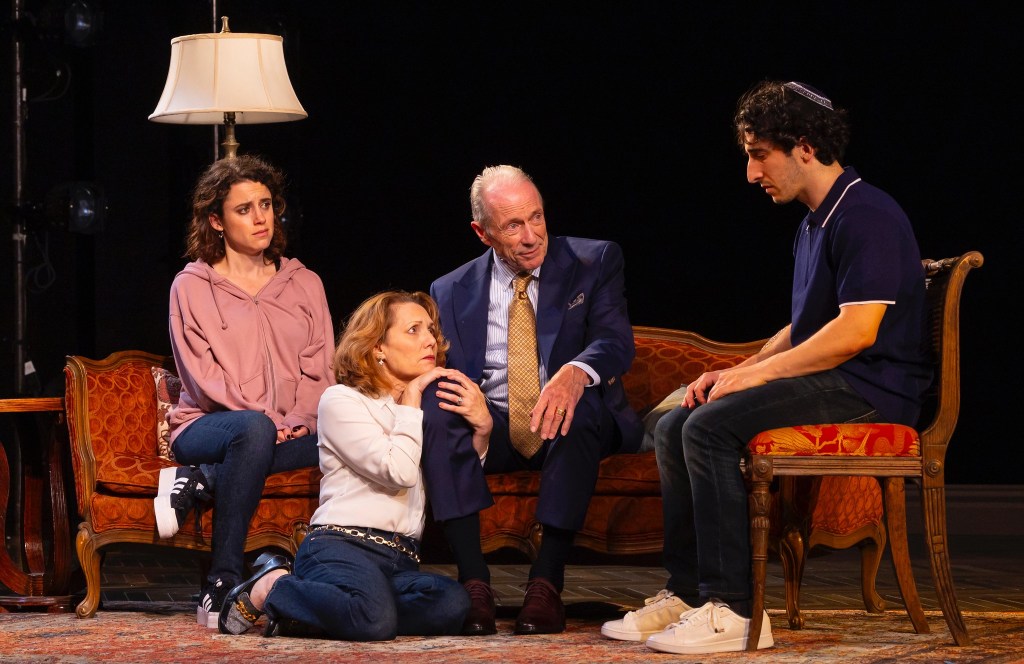
But when their son Daniel (Joshua Chessin-Yudin) comes home beaten up because he was wearing a yarmulke, they are forced to question their safety and sense of belonging in the country they love.
The matriarch of the family is Marcelle Saloman Benhamou (an excellent Amy Resnick), a psychiatrist, who welcomes a distant cousin named Molly (Tallia Sulla) who is visiting from the U.S. Marcelle twice painstakingly explains the family ties for the benefit of the character and us.
Husband Charles Benhamou (Nael Nacer), a physician, is increasingly dismayed at the level of violence Jews are facing in France and is exploring what a more welcoming country – such as Israel – might offer. “It’s the suitcase, or the coffin,” he openly declares.
Marcelle is against it and has much to lose; she has finally been named chair of her department and her aged father Pierre (Will Lyman) still runs the family’s piano store.
A complication: Marcel and Charles represent two strands of French Judaism: Marcelle’s Ashkenazi ancestors have been rooted in France for centuries, while Charles’s are Sephardic Jews who lived in North Africa for generations before relocating from Algeria in the 1960s.
Marcelle’s brother Patrick (Tony Estrella), who narrates, is irreligious, and has made the decision to assimilate, which he believes is a practical and safe way to proceed in the current climate; he and Charles eventually have it out.
The rest of the family is not shy. Daughter Elodie (Carly Zien) recalls Daphna from Harmon’s “Bad Jews” and is a highly opiniated, well-informed woman who injects jolts of energy into the conversation with every point; Harmon gives her a rant to remember.
Daniel, meanwhile, is intrigued by Molly, who becomes a frequent visitor to the apartment but eventually comes into the crosshairs during a family debate.
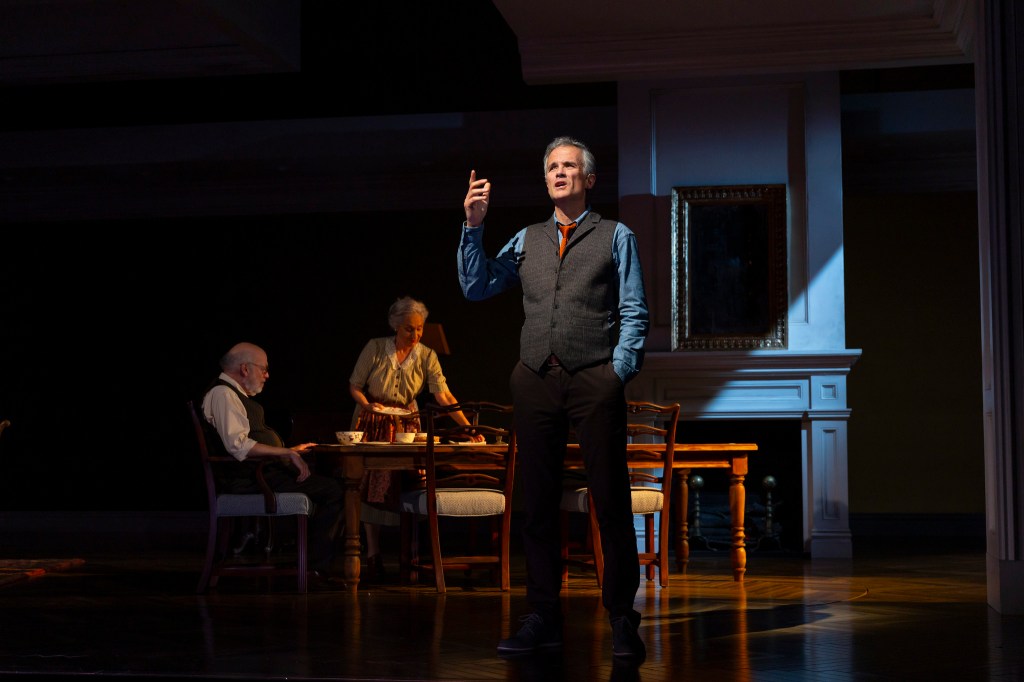
Harmon often flashes back to the same apartment from 1944-46, during the last years of World War II. Marcelle and Patrick’s grandparents, Irma Salomon (Phyllis Kay) and Adolphe Saloman (Peter Van Wagner) are laying low, somehow hanging onto their piano store while awaiting word on the fates of their relatives in concentration camps.
Jared Troilo has a fine dramatic turn as Irma and Adolphe’s son Lucien, who returns after the war to the apartment with son15-year-old son Pierre (Jessie Kodama) in tow after suffering an unspeakable loss.
Will Lyman is Marcelle and Patrick’s father Pierre, who eventually took over the store after working for Lucien. Lyman has long been one of the pillars of the Boston theater scene, and here he helps tie things together in the climatic Act III when the family finally makes its decision to stay or go.
Harmon’s previous works — Bad Jews, Admissions, and Significant Other – have been welcomed and celebrated by Boston audiences at the SpeakEasy Stage Company.
Director Loretta Greco, who began her first full year as Huntington artistic director with this work, has a long professional relationship with Harmon, including a run of Harmon’s “Bad Jews” at San Francisco’s Magic Theatre. It allowed her to begin her work on this play with a certain level of comfort, comfort that she has been able to pass on to her cast. The precise timing on the back-and-forth’s in the family “discussions” are an example of it.
There is a moment late in Act III when the entire family gathers around and offers theories about why the Jews have been so persecuted through the centuries.
They come hot and heavy. “They hate us because they can’t understand why we are still here” is perhaps the best.
The Huntington has a reputation for sublime production values, earned over several decades, and this show is no different. Start with Andrew Boyce’s Parisian apartment, complete with a revolving turntable, and add Alex Jaeger’s costumes, Christopher Akerlind’s lighting, which excels in the most dramatic moments, and sound design and composition by Fan Zhang. Charles Haugland’s dramaturgy is consistently excellent.
At the end of the production “La Marseillaise” is sung by the entire cast, with a bit of irony. But it highlighted perfectly the push and pull of Jews and their existence in a country where, like many others, seemed to welcome them in before turning them away.
I spent two weeks in Paris in a walk-up apartment one November near the jazz clubs and the Pompidou Centre in the 4th arrondissement. Across the street from the apartment was a train station with a large bakery. Each morning, I went across the street for fresh croissants. And, as Harmon and his characters noted, they were “wonderful.”
“Prayer for the French Republic” is set to open on Broadway this winter after an award-winning off-Broadway run in 2022.
The odds are that a play that touches on so many important issues, always with heart, humor and great humanity, will be a success once again.
The Huntington production of Joshua Harmon’s “Prayer for the French Republic.” Directed by Loretta Greco. At the Huntington Theatre, 264 Huntington Ave., Boston Through Oct. 8. Huntingtontheatre.org
Discover more from onbostonstages
Subscribe to get the latest posts sent to your email.