Long-running musical ‘Chicago’ is indestructible
By Rich Fahey
BOSTON – Almost a half-century ago, a musical debuted on Broadway to mixed reviews, being nominated for 11 Tonys but winning none, running into a buzzsaw called “A Chorus Line.”
Thankfully, Broadway – like the two murderesses at the heart of the musical in question – believes in second chances.
The original “Chicago” debuted in 1975 and ran for two years but the revival of “Chicago” hit Broadway in 1996 and won six Tonys in 1997 and has never looked back. It has run more than 10,000 performances on Broadway as the longest-running musical in history and spawned a series of national tours, the latest of which is being presented by Broadway in Boston through Sunday, Dec. 3 at the Emerson Colonial Theatre.
The musical about murder and mayhem in Chicago in the Roaring 20’s has gilt-edged credentials. The music and lyrics are by John Kander and Fred Ebb (“Cabaret”), with a book by Ebb and renowned director/choreographer Bob Fosse, who directed and choreographed the original production.
The musical also spawned the Oscar-winning 2002 film version.
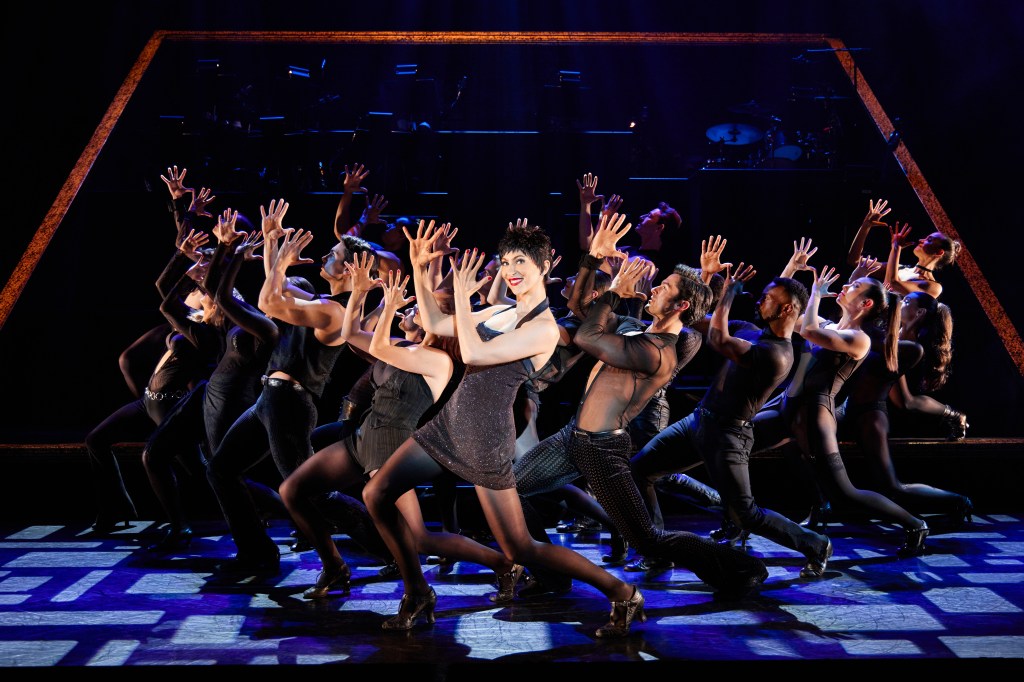
This production is a sleek, sassy, sexy show, with Fosse’s signature style of choreography redone by Ann Reinking in his style for the revival that is still running. William Ivey Long’s costumes have many of the characters – especially Roxie and Velma – strutting across the stage in an assortment of lingerie, short dresses, and see-through mesh shirts.
In the roles of the women whose crimes make headlines in the Chicago tabloids, Kailin Brown as Velma Kelly and Katie Frieden as Roxie Hart fill the bill and then some. Brown is sleek and athletic as she glides across the stage, a singer and dancer accused of murdering her husband and sister. Frieden’s Roxie is a bored housewife married to a mousy mechanic named Amos (Robert Quiles) who kills her lover and believes she can turn the publicity around the murder into a career – if she can only avoid the hangman’s noose. She plots her course in “Roxie.”
Velma, meanwhile, is the top dog on the cell block and plotting her own future after her acquittal until Roxie upstages her, grabbing the headlines and the public’s interest. Celebrity is fleeting, and that goes double for infamous celebrity.
There is no set to speak of; chairs are used as props and the band – an excellent, energetic group giving full voice to the jazz-infused Kander-Ebb score – seated vertically on stage.
Velma and Roxie land the same cell block with other female murderers, all of whom are as “innocent” as Velma and Roxie and lay out their reasoning in “Cell Block Tango.” They are all under the thumb of Matron “Mama” Morton (Illeanna “illy” Kirven), who lays down the law in “When You’re Good to Mama.”
Connor Sullivan shines as the flamboyant lawyer Billy Flynn. who prefers staging a show in the courtroom to trying to defend his murderous clients, He’s a very competent singer-dancer and he’s able to pull off one of the show’s classiest – and funniest – numbers as he tries to convince us that “All I Care About is Love.” His second-act “Razzle Dazzle” gives him a chance to test his rock-solid vocal skills.
The fame generated by committing infamous acts actually was based on a time in Chicago when murder was a form of sensationalized entertainment, and those accused – especially attractive women – became celebrities. The OJ Simpson murder case probably gave a boost to the 1996 revival.
“Chicago” – with its timeless score, sexy, sassy choreography and hilarious take on our celebrity culture – is pretty much indestructible at this point. And it shows no signs of slowing down.
The Apex Touring Production of “Chicago.” Lyrics by Fred Ebb, Music by John Kander. Book by John Kander and Bob Fosse. Based on the play by Maureen Dallas Watkins. Originally directed and choreographed by Bob Fosse. Original New York production directed and choreographed by Walter Bobbie and Ann Reinking. Re-creation of original production choreography by Gregory Butler. Re-creation of original production direction by David Hylsop. Scenic design by John Lee Beatty. Costume design by William Ivey Long. Lighting by Ken Billington Sound design by Scott Lehrer. Presented by Broadway in Boston through Dec.3 at the Emerson Colonial Theatre. BroadwayinBoston.com.
Discover more from onbostonstages
Subscribe to get the latest posts sent to your email.