‘Galileo’s Daughter’ is a journey worth taking
By Rich Fahey
CAMBRIDGE – Yes, indeed, the co-production of “Galileo’s Daughter” by the Central Square Theater and the WAM Theatre is about the daughter of famed 17th century scientist Galileo Galilei.
But it is also very much about a playwright’s journey to Italy to find her muse in the form of a cloistered nun who led a life of hardship.
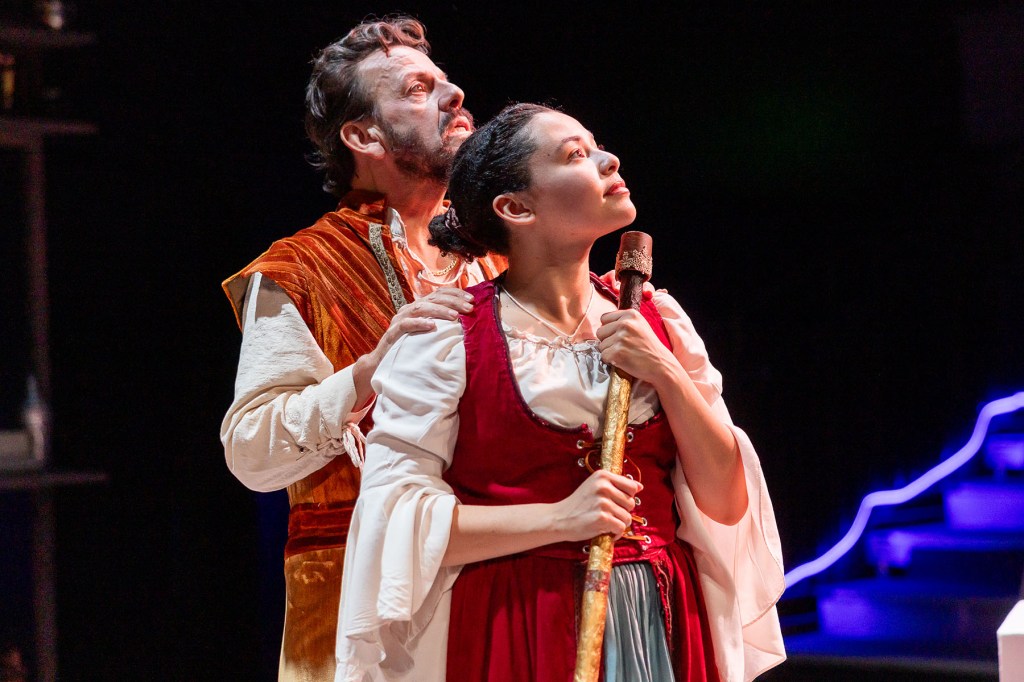
Playwright Jessica Dickey framed the piece around an unnamed writer – the narrator of the play — who makes the journey to Florence to research the letters of Sister Maria Celeste, with Sandra Seoane-Seri giving a warm and wonderful performance in the role of the nun.
Caroline Kinsolving is thoroughly engaging as the writer, undergoing a personal crisis herself as she struggles to unlock the secrets Sister Maria Celeste left behind in 124 letters written between 1623 and 1634. Those letters inspired both the character of the writer and Dickey herself, who learned about the “rock star nun” by reading Dava Sobel’s acclaimed 1999 book “Galileo’s Daughter: A Historical Memoir of Science, Faith, and Love.” In writing the book, Sobel translated the 124 letters into English.
Diego Arciniegas, who led the much-missed Publick Theatre of Boston for many years, puts on a dizzying, dazzling display of split-second timing, a true virtuoso performing theatrical magic as he inhabits not only Galileo, but every other male character in the play. That includes a panoply of frustrating Italian bureaucrats the writer encounters along the way towards getting to Sister Maria’s letters, an evil Friar as well as a scientist sympathetic to the writer. In the blink of an eye, Arciniegas changes characters, voices, accents and costumes.
“Galileo’s Daughter” takes place in both in the 17th and 21st centuries and Director Reena Dutt has found several effective ways of connecting the action in the two centuries. At times, the writer and Sister Maria are circling the outside edges of the set as they speak; in other moments, the writer can be seen in different places on the set during scenes between Galileo and his daughter. The pace of the story is brisk and moves smartly during the 80 minutes.

The set design by Qingan Zhandg artfully accomplishes a lot in a small space, allowing action to flow among several sites in contemporary Florence, back to the 17th Century convent in San Matteo and Galileo’s Tuscany.
Because Virginia Gamba was illegitimate, there were very few options open to her in the 17th Century. The decision to enter the San Matteo convent as Sister Marie Celeste at age 16 kept her safe, but apart from the life she hoped to spend alongside her father, the iconic astronomer, engineer and physicist.
She could not marry and after a time she could no longer work with her father, due to the danger of being closely associated with a man whose views asserting the earth revolved around the sun were judged to be heresy by the Catholic Church.
Galileo did raise his daughter to the light, educating her and explaining his work, and the scenes between he and his daughter are loving and genuine.
The adjustment to convent life for Sister Maria was understandably hard, but in her program notes, CST Artistic Director Lee Mikeska Gardner notes that, while there, she found a way to become a healer, an accountant, a stage director and actor, a realtor and a mediator, and yet her story was almost lost to history.
Dickey is an award-winning playwright who also acts and writes for both TV and the screen. In an interview she did with the WAM Theatre of Lenox, Mass., the co-producer of this production, she claimed that she did not try to make the play autobiographical; but it happened in spite of her efforts to avoid it. Dickey said like the writer in her play, her “life blew up,” she traveled to Italy, and the resulting play chronicles that journey.
“Galileo’s Daughter” is a production of The Catalyst Collaborative @ MIT initiative, which is celebrating 20 years of presenting theater that deepens public engagement in science, and is the 35th production under its aegis, including five new play commissions. They have been consistently both entertaining and engaging.
In this instance, playwright Dickey, director Dutt, an excellent cast and a skilled set of designers have made sure the story of Sister Maria Celeste is creatively, thoughtfully and skillfully told, and that it will not be lost to history.
“Galileo’s Daughter.” Written by Jessica Dickey. Directed by Reena Dutt. At the Central Square Theater, Cambridge, through Dec. 8. Centralsquaretheater.org.
Discover more from onbostonstages
Subscribe to get the latest posts sent to your email.