Make your appointment to visit ‘Jaja’ and friends
By Rich Fahey
BOSTON –– As they painstakingly arrange the hair braids they use to give their clients a new identity, their lives also become intertwined and connected with their fellow workers.
The hair artists who work in the salon known as Jaja’s African Hair Braiding, in the heart of Harlem, are living life on the edge. That’s because the women who hail from West Africa are all immigrants, and their status affects every aspect of their hopes and dreams.
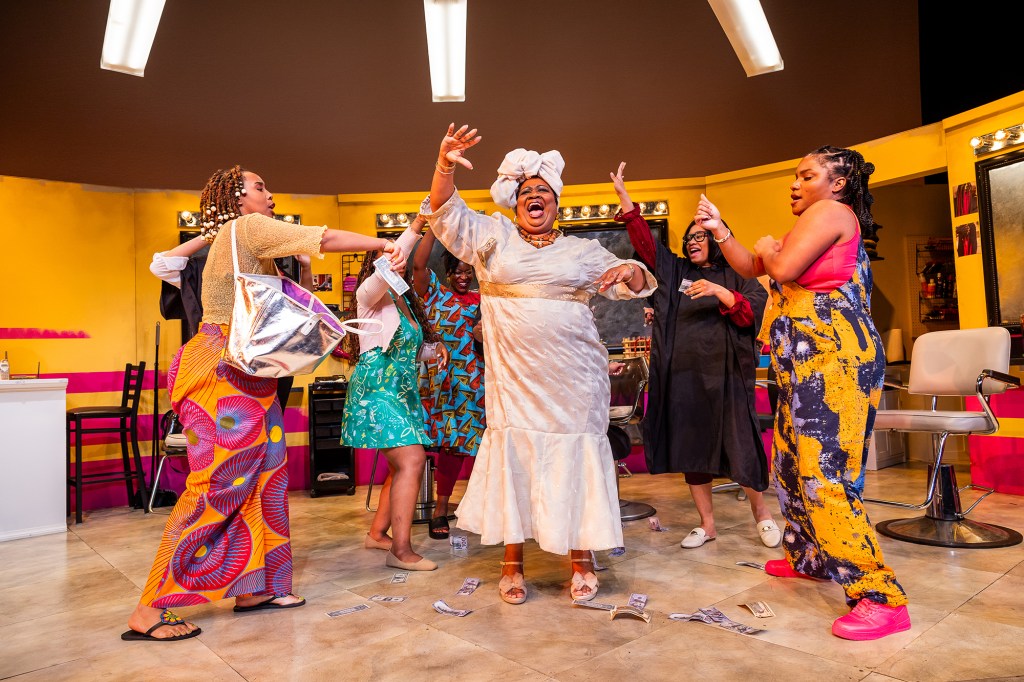
The hair salon has always been seen as a safe space for Black women, and in Jocelyn Bioh’s “Jaja’s African Hair Braiding,” now being presented by SpeakEasy Stage Company through May 31 in the Calderwood Pavilion of the Boston Center for the Arts, it is that and much, much more. Despite rivalries – they are all independent contractors competing for customers — it is a home away from home where sadness, frustration with an unhappy marriage, juicy gossip, and the joy of a winning lottery ticket can all be expressed freely.
“Jaja,” which earned five Tony nominations on Broadway in 2023, is a warm-hearted, upbeat look at the happenings in the course of one hot summer day in July, 2019. Customers will come and go, friendships will be broken and repaired, all against the backdrop of the impending marriage of salon owner Jaja (MaConnia Chesser) to a white man that should guarantee her a green card and the ability to stay in the United Staes.
A Senegalese immigrant, Jaja’s other goal is also to provide the means for her smart and ambitious daughter, Marie (Dru Sky Berrin), who came to the country when she was four, to fulfill her dreams. On the day in question, Marie is running the salon for her mother, but there is a cloud over her. Her education has come via false paperwork, clouding her college dreams.
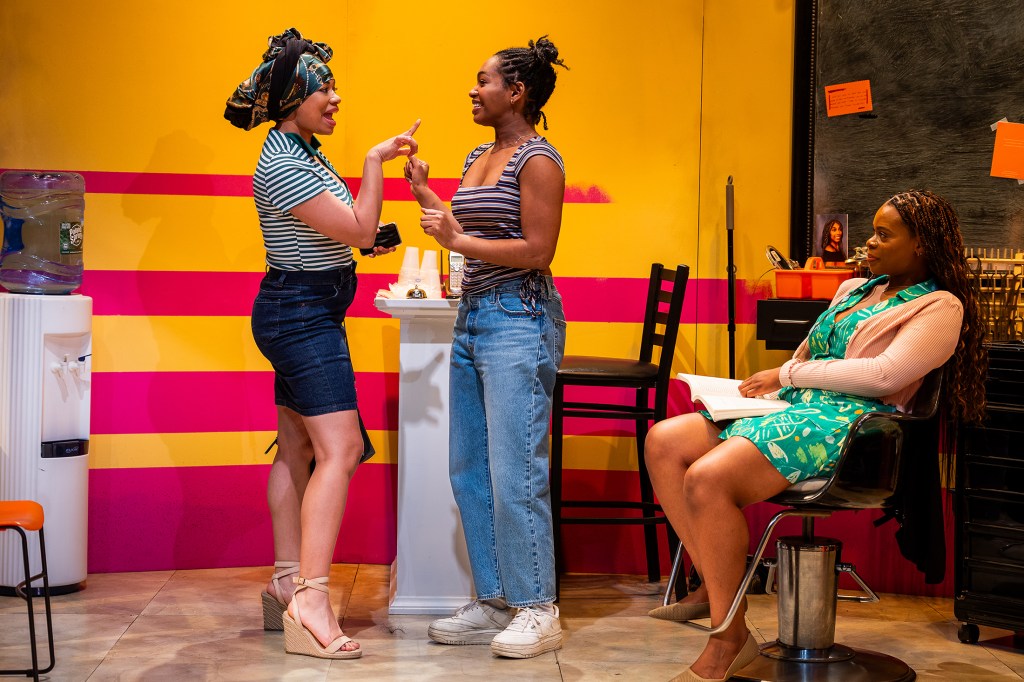
The backstories of the stylists are filled in one by one. There is Bea, (Crystin Gilmore), the longest-serving worker, a garrulous native of Ghana determined to open her own shop someday. She is wary of the newcomer, a young Nigerian named Ndidi (Catia) who works quickly and efficiently and is becoming a favorite of customers – including ones once served by Bea.
Aminata (Kwezi Shongwe), who is often allied with Bea, is a Senegalese woman who is good at her job and fun-loving but fed up with her turbulent marriage.
Miriam (Marhadoo Effeh) has recently emigrated from Sierra Leone and misses a young daughter she desperately wants to bring to America.
Hampton Richards is Jennifer, a Black journalist braiding her hair for the first time; she spends an entire day getting micro braids that she believes will give her a new outlook on life.
Ashley Aldarondo has a nice turn as Vanessa, an ultra-difficult client and Joshua Elumide deftly juggles several male parts, including vendors who come to sell their wares while oozing charm.
Jaja will not make her grand entrance — resplendent in her wedding gown — until well into the play, and what happens next will require the group to completely abandon their individual needs to attend to the greater good.
Playwright Bioh uses great good humor to mask the underlying fears and insecurities common to immigrants whose whole lives can be turned over in an instant.
We learn to appreciate that hair braiding is grueling, painstaking work, done over a long period of time, with all kinds of styles: From jumbo box braids to cornrows to micro braids.
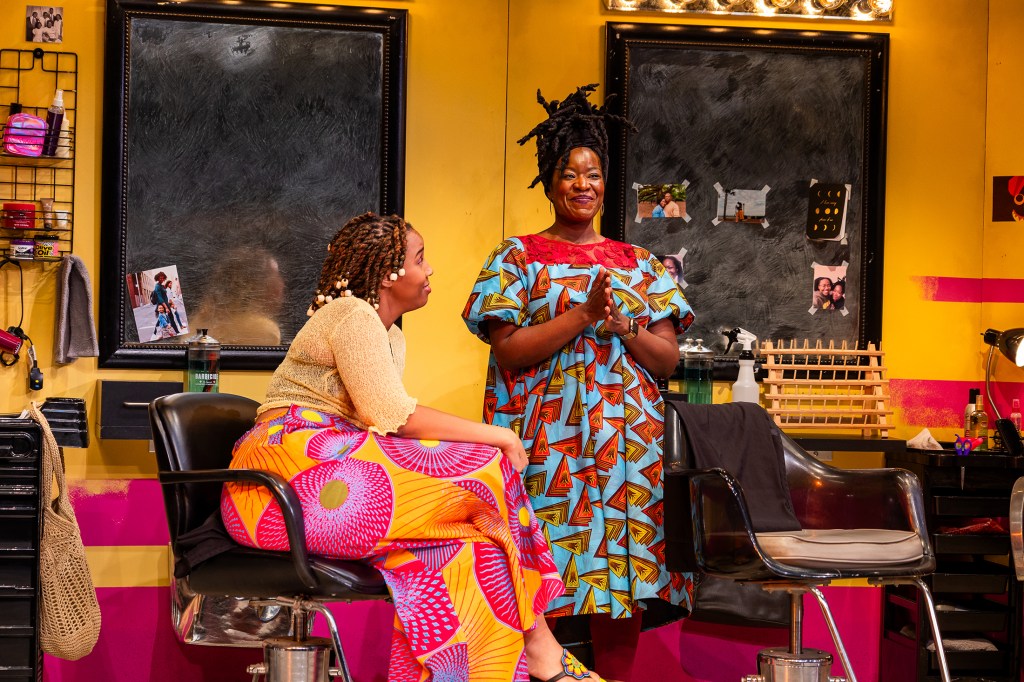
“Jaja” benefits from some sublime production values, from Jane E. Howland’s stylized painted shutters that are pulled back to reveal the colorful salon within, Danielle Domingue Sumi’s bright costumes, Christopher Brusberg’s lighting, Aubrey Dube’s sound design and Najda Vanterpool’s hair and wig design, while also helping the actors to skillfully portray the hair braiding itself.
The idea of the hair salon as a safe place for Blacks to express themselves has been seen here before. In 2018, the American Repertory Theatre presented Inua Ellams’ “Barbershop Chronicles,” exploring the lives and conversations of Black men in barbershops across Africa and England.
Outgoing SpeakEasy Artistic Director Paul Daignealt selected “JaJa” as the last work to be presented in his final season after SpeakEasy’s success in 2019 with Bioh’s earlier work, “School Girls: Or, The African Mean Girls Play.” Daigneault, since founding the troupe in 1992, has led it to its current standing as one of the top regional theaters of any size in the area. Dawn M. Simmons was appointed his successor on March 27.
One aspect of SpeakEasy that continues to excel is its dramaturgy, including for this show a primer on the history of black hair and its importance in black culture. SpeakEasy’s attention to details has given reviewers important context.
Bioh, also a celebrated actress, is a Ghanian-American who was born and raised in Harlem and has been getting her hair braided since she was 4; thus she believes she was “destined” to write “Jaja.” She got to know the women who worked in the salons and describes her work as a love letter to the women and Harlem itself.
Director Summer L. Williams said in a recent interview the current political climate and watching people “be left behind, abducted, and disappeared” has ratcheted up her sense of urgency since she began work on “Jaja” a year ago. In program notes, she said: “Now, I feel additionally motivated to share these characters’ stories in the hopes that folks are energized to take action.”
“Jaja’s African Hair Braiding.” By Jocelyn Bioh, presented by SpeakEasy Stage Company. At Calderwood Pavilion at Boston Center for the Arts, May 2-31. Tickets from $25. 617-933-8600, www.SpeakEasyStage.com
Discover more from onbostonstages
Subscribe to get the latest posts sent to your email.