CST’s ‘Breaking the Code’ is an artistic triumph
By Rich Fahey
CAMBRIDGE – His genius set the stage for that ever-smarter Smartphone you have in your pocket.
Yet in the end his life was that of a tragic hero, someone who helped turn the tide of World War II before a combination of homophobia and hypocrisy made for a most unhappy ending.
A superb cast led by Eddie Shields under the unwavering direction of Scott Edmiston brilliantly brings the story of Alan Turing to the stage in Hugh Whitemore’s “Breaking the Code” at the Central Square Theater.
Whitemore doesn’t get bogged down in the weeds of how Turing and his team solved the Enigma puzzle, instead focusing on Turing the person, his accomplishments and his place in history. And, of course, his disgraceful treatment at the hands of homophobic hypocrites.
Shields has compiled a lengthy string of artistic triumphs in productions such as “The Inheritance,” “A Man of no Importance” and “Angels in America” and here he lights the lamp again as Turing. No less an authority than Winston Churchill said that Turing made the single biggest contribution to the Allied victory over the Nazis when he broke the Germans’ Enigma Machine codes, saving an untold number of lives. He also worked on one of the first machines recognized as a modern computer and imagined devising a machine that could outwit humans. AI, anyone?
Sheilds moves effortlessly between Turing as a young man and then as an adult, his love of mathematics inevitably leading him to computers and codebreaking.
Turing’s pioneering work with early computers brings him to the attention The intensityof Dilwynn “Dilly” Knox, (David Bryan Jackson), an “old-school” Brit and classically-trained cryptographer who recruits Turing to join the Government Code and Cypher School. Knox recognizes Turing’s brilliance early on but also advises him to be more circumspect in his relationships lest they derail his career.
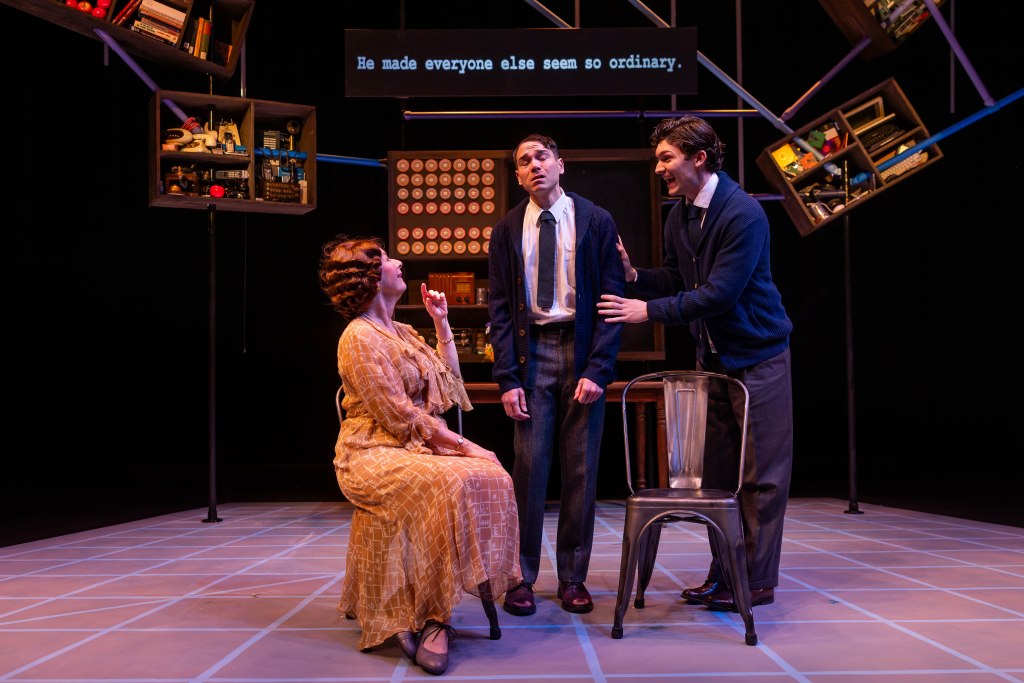
While working at Bletchley Park on the Enigma Machine, he becomes fast friends with a female colleague named Pat Green (Josephine Moshiri Elwood). She knows he is gay but they are simpatico in many ways, and it is an era when many gay British men chose to marry and stay in the closet; they choose to stay close friends and she later marries and becomes a mother.
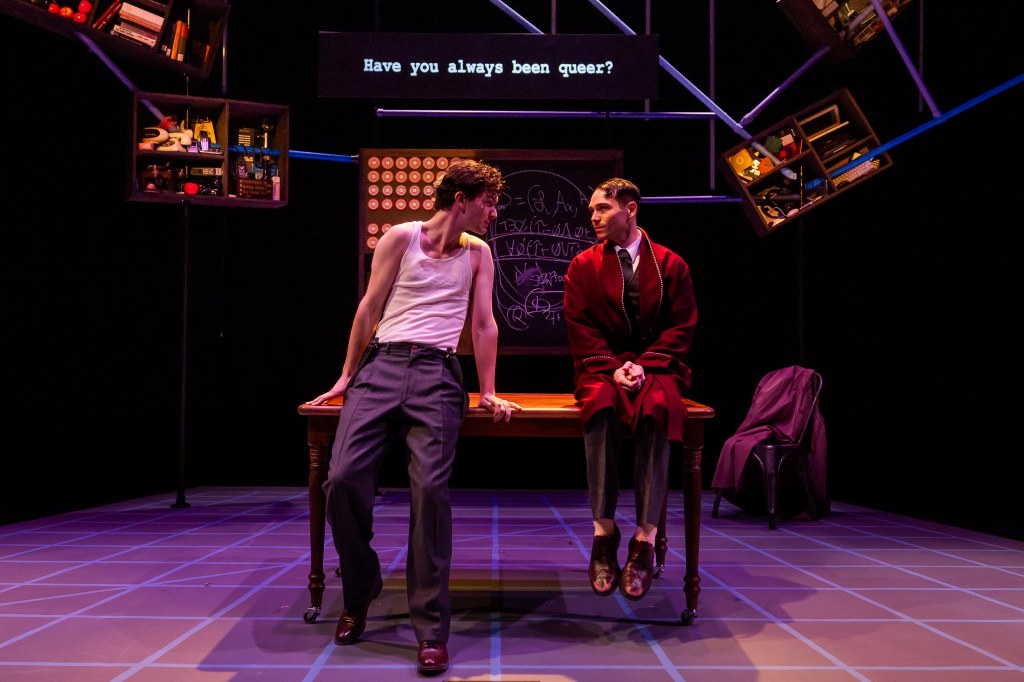
In essence, Turing convicted himself of a crime in his testimony to detective Mick Ross (Dom Carter) about a burglary at his apartment, detailing an affair with a young man that he believed wrongly was no big deal. That eventually led to his conviction of “gross indecency” in 1952 that put him behind bars and subjected him to a barbaric chemical castration. It also revoked his security clearance, essentially ending his career and subjecting him to further harassment that eventually led to his suicide.
60 years later, Turing was pardoned and honored for his contributions to war effort.
There is a harrowing, wrenching scene – a short master class in acting — in which Turing both comes out to his mother Sara (the inimitable Paula Plum) and reveals his legal troubles. Sara is horrified at first, knowing what it will mean to her son’s life, reputation and career, but her eventual love and support throws a life preserver to a man on the brink.
Matthew Beagan provides solid support in a variety of roles, including Turing’s lover, friend and as a modern-day gay student at one of the schools Turing attended talking about the importance of Turing’s legacy and the rights he now enjoyed as a member of the LGBTQIA+ community.
The production values, led by the constantly evolving and improving use of projections — and ongoing advancements in lighting and sound – are sublime.
Janie E. Howland’s set puts us foursquare in Turing’s world with its formulas, equations and mathematical problems via a series of monitors that serve as guides and adjuncts to what is happening onstage. The projections by SeifAllah Salotto-Christobal, Karen Perlow’s lighting and Audrey Dube’s sound work in combination to make the overall work a treat for the senses.
Edmiston is a master of pacing and making sure the actors’ portrayals are staying within the lines; the production flows beautifully.
I reviewed CST’s production of “Breaking the Code” in 2011 with Allyn Burrows as Turing. He was brilliant in his own way and this surely is a case of two actors making the role their own.
This production includes an epilogue by Neil Bartlett written in 2025 that is making its American premiere at CST.
“Breaking the Code” combines artistic brilliance and scientific brilliance to make a powerful, engrossing evening of theater.
The Central Square Theater/Catalyst Collaborative @MIT Production of “Breaking the Code.” Play by Hugh Whitemore based on the book “Alan Turing: The Enigma” by Andrew Hodges, with a new epilogue by Neil Bartlett. Directed by Scott Edmiston. At the Central Square Theater through April 26. Centralsquaretheater.org
Discover more from onbostonstages
Subscribe to get the latest posts sent to your email.