Reimagined ‘Oedipus’: A tragic king in the barrio
By Rich Fahey
BOSTON — From the beginning we know the ending; we are watching a slow-motion deadly car crash with many casualties.
Sophocles wrote “Oedipus Rex” around 430 BC, so we have had almost 25 centuries to ponder its greatness and the lessons it teaches on its way to the unspeakable tragedy, he story of a king who seemingly can do no wrong but has actually been doomed from birth.
What if the truths Sophocles wrote about then could be transferred to modern civilization, and especially a specific ethnic group? That’s what playwright Luis Alfaro has crafted in The Huntington’s powerful presentation of “Oedipus El Rey,” now at the Calderwood Pavilion of the Boston Center for the Arts through June 14.
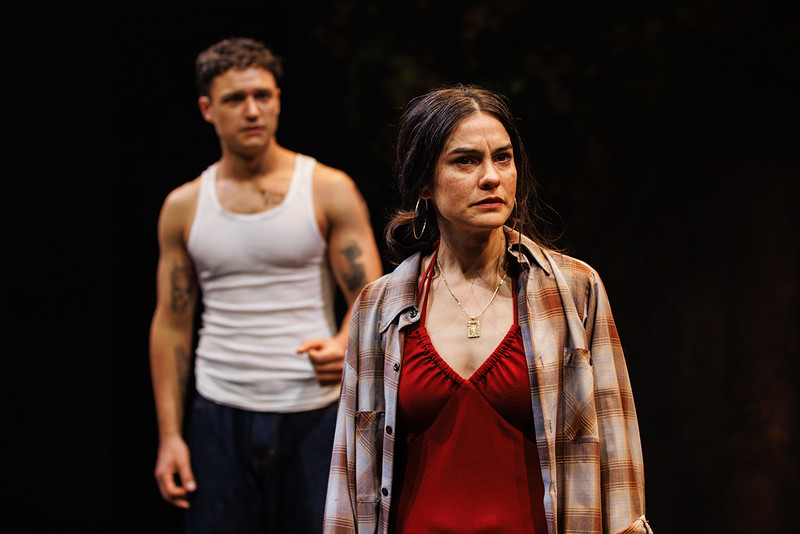
This Oedipus is set in Los Angeles, and the traditional Greek chorus in this case is Chicano, four orange-clad prisoners letting us know who is in the play and the tale they are about to tell. The El Rey (Spanish meaning king) of the title rules over the barrio, or neighborhood, and nothing goes on there without his say-so.
The Greeks, as always, had a word for it. It is hubris, or false pride, and it is evident in everything Oedipus (Juan Atruro) says or does, and the prisoners have taken notice as he rises to replace Creon (Jaime José Hernández) as leader of the pack. He is physically more imposing than the others, even if he walks with a limp.
Early on, the storyline follows – in its own way — much of the path Sophocles laid out. When it is foretold to gang leader Laius (Gabe Martinez) that his newborn son might someday grow up and kill him, Laius gives the child to the blind Tiresias (Victor Almanzar) with orders to kill him. Laius also cuts the bottom of the child’s feet so the child won’t chase him in the afterlife.
But Tiresias instead raises Oedipus to the light, even when they are both prisoners, and Oedipus believes him to be his biological father; he has no clue to the identity of his mother.

After his release from prison, Oedipus finds a taste for death when he kills a mysterious man who taunts him as he returns to Los Angeles. He then persuades Creon, a former fellow prisoner, to let him stay temporarily at the apartment Creon shares with his sister Jocasta (Melisa Soledad Pereyra), in mourning after the death of her husband Laius, the former leader of the Chicano gang. Flirtations can’t mask immediate attraction.
There is delicious irony in the celebration of the incestuous and erotic joining of Oedipus to Jocasta, an event celebrated with lights, music and dancing and audience members invited to participate in what will turn out to be a tragic event.
Yes, we are watching a slow-motion car crash, but that doesn’t matter, because Alfaro’s adaptation, Loretta Greco’s direction and the acting combine so that the ending is no longer the focal point; it’s the how and why of how they got there that really matters, and the skillful transfer of the story to the barrio.
The marriage that follows the incestuous coupling is a more solemn event. Eventually, Oedipus, having raised himself from poverty to be a king, has killed his father and married his mother.
Three of the male characters also double as prisoners/chorus members, with Javier Davis also part of the chorus, performing the role of El Sobador and serving as fight captain.
Playwright Alfaro grew up, in his own words, “extremely poor” in a very violent gang neighborhood in downtown LA, so he knows whereof he speaks in the setting of the piece. The setting is marked largely by the vivid projections by the Tony Award-winning Hana S. Kim, who is also credited with the spare scenic design, which includes the walls of the prison and two large doors.
Sound designer Jake Rodriguez composed original music for the show, with lighting by Reza Behjat and costumes by Alex Jaeger. Rodriguez, Kim and Jaeger worked with Director Greco on earlier stagings of the play. Together they firmly establish not only a time and place, but a cultural vibe that is vital to the show’s success.
Greco and her designers have also configured the versatile Roberts Theatre to make it very intimate and the onstage action in-your-face, with the audience surrounding the actors on three sides. Because of the intimate setting of the 100-minute production, those leaving are denied re-entry.
While most theater companies have abandoned ship when it comes to programs, The Huntington’s dramaturgy continues to shine, with a glossary of key Spanish words, a synopsis of the original “Oedipus,” and an interview with playwright Alfaro.
Alfaro, Greco et al have made “Oedipus” their own, and 25 centuries later, the reimagined story has not lost its power as it tells the tale of lost souls in the barrio, struggling to avoid what fate has in store for them.
The Huntington production of “Oedipus El Rey.” Written by Luis Alfaro. Directed by Loretta Greco. In the Roberts Theatre in the Calderwood Pavilion of the Boston Center for the Arts through June 14. Huntingtontheatre.org
Discover more from onbostonstages
Subscribe to get the latest posts sent to your email.