NSMT’s ‘Other Phantom’ need not take a backseat
By Rich Fahey
BEVERLY – When making Gaston Leroux’s 1910 novel “The Phantom of the Opera” into a musical, events showed there were two very different ways to approach the material. And history has proven both correct.
The North Shore Music Theatre is now presenting Yeston & Kopit’s “Phantom” through Nov. 1, and it has great bones, with the score by Tony-winning composer Maury Yeston and a book by award-winning writer Arthur Kopit.
The two were planning to bring their work to Broadway when Andrew Lloyd Webber announced his “The Phantom of the Opera,” a huge hit in London, would be coming to America in 1988. Fearing the direct competition, Yeston and Kopit’s financial backers pulled out, forcing them to shelve the project.
Kopit later adapted his unproduced stage book into an NBC two-part miniseries titled “Phantom” (starring Burt Lancaster), which aired in 1990.
After seeing that his and Yeston’s approach were completely different from Lloyd Webber’s, Kopit and Yeston finally allowed the stage version to premiere at Theatre Under The Stars (TUTS) in Houston, Texas, in 1991. While it never made it to Broadway and has not been the blockbuster its cousin has, it has proven far more accessible when it comes to being staged. It has been produced more than 1,000 times, with NSMT first staging it in 1992, marking the first of the 67 productions at the theater that actor David Coffee has performed in.
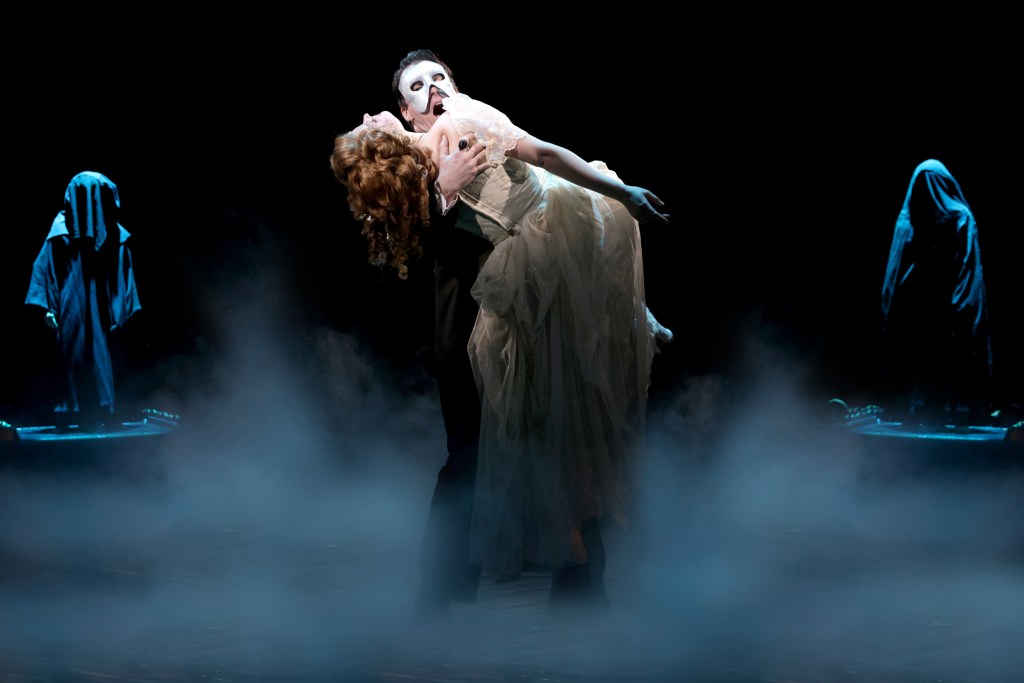
This “Phantom” is a heartfelt Gothic love story of the first order. It has mystery, passion and suspense, and just because there’s no falling chandelier doesn’t mean that staging the work is a piece of cake. NSMT has employed a cast of 26, and moments such as the famous lagoon scene when The Phantom (Sean Seamus Thompson) spirits Christine Daaé (Madison Claire Parks) down into his lair beneath the Paris Opera House are a technical nightmare.
In this telling, The Phantom has an extensive backstory. He even has a name; he is called Erik, born a disfigured baby boy who has spent his life deep underground the opera house, cared for by his loving mother Belladova (Keliah Schertz). He has also, along the way, become a musical wunderkind in his own right as a young boy, as the music drifts down from the stage above. Eventually, he is joined by a group of hooded acolytes, other displaced souls from the streets of Paris.
As it begins, Christine Daaé is singing on Paris street corners and selling sheet music to songs such as “Melodie de Paris” to stay afloat. Then her talent and beauty capture the eye of Count Philippe de Chandon (Christian Probst). He is a supporter of the Paris Opera and gives her his card to present to Company Manager Gérard Carrière (Gregory North) to get her needed singing lessons.
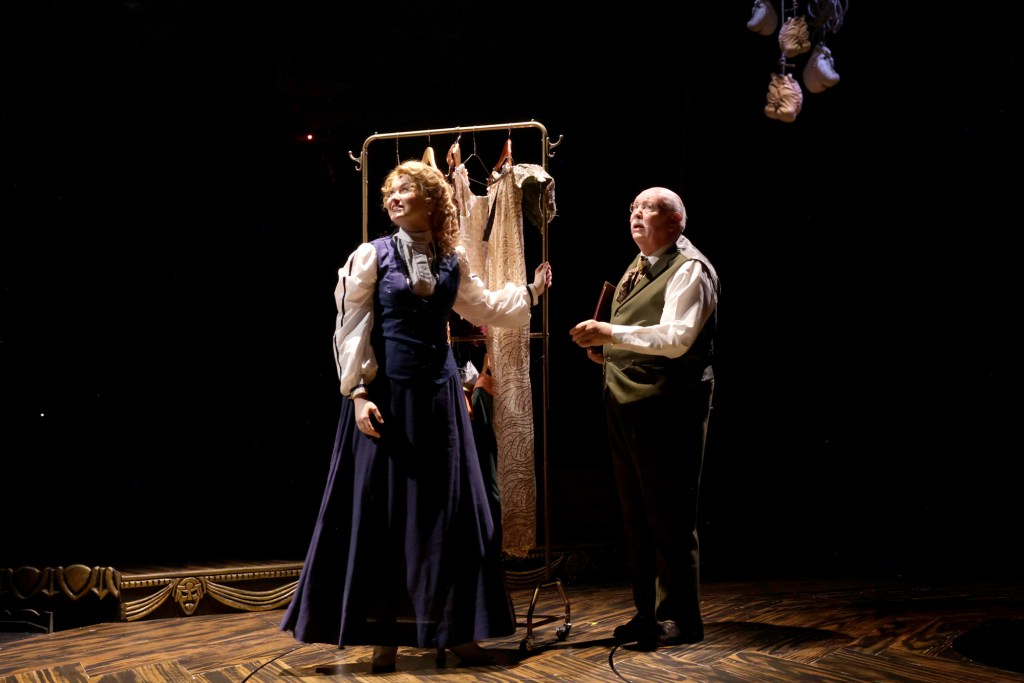
But before that can happen, the opera is sold to Alain Cholet (Alex Syiek) and his wife Carlotta (Victoria Huston-Elem), a perpetually off-key diva who appoints herself company manager and whose voice torments The Phantom. She fires Carrière, who has secretly been supporting Erik, and sends her costume manager down into The Phantom’s lair to tally costumes and sets from pass productions. His encounter with Erik accidentally sets off a chain of violence Erik never wanted and Carrière is powerless to prevent.
Coffee finds the humor and heart in reprising the role of Jean Claude, the genial stage manager of the opera house who befriends Christine and gets caught up in the chaotic events
Christine is hired by Carlotta in a minor job but Erik secretly begins giving her lessons, quickly falling in love with both the woman and her voice. The new owner “discovers” Christine and she is ready for her opera debut when a jealous Carlotta’s scheme derails her. Erik carries Christine away into the catacombs below. Her scheme is discovered and revenge is in the air.
But the Count de Chandon is also intent in making Christine his own, and he joins the pursuit of The Phantom in the catacombs.
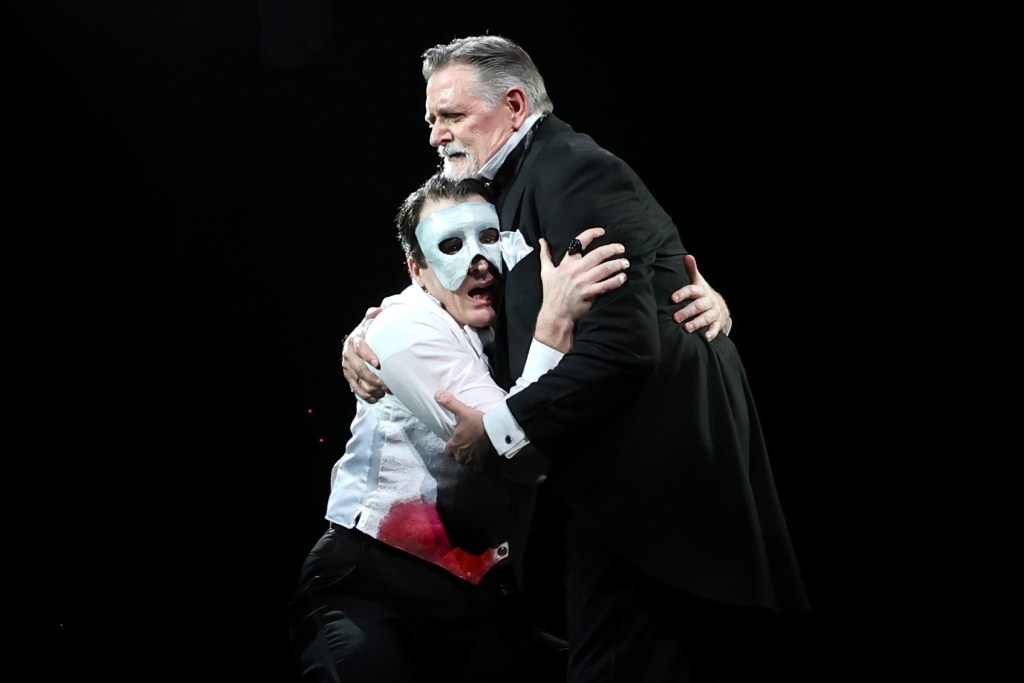
Eric’s disfigurement is handled carefully and with sensitivity by Kopit. We never see him without his mask, but there is a heartbreaking moment when Christine does, and she is horrified.
Kopit’s plot twists include Erik’s true relationship with Carrière.
The songs by Yeston are in style and tone more traditional musical theater pieces than Lloyd Webber’s more bombastic score, with highlights such as “Melody de Paris,” the lovely duet “Home,” “Where in the World” and “You are Music.” Dale Rieling leads a 10-piece orchestra that gives full voice to Yeston’s score.
The direction by Robert W. Schneider and the production values are sublime, from Jack Mehler’s scenic and lighting design, Elizabeth Weidner’s sound, Rachel Padula-Shufelt’s wig and hair design, and Rebecca Glick coordinating Martha Clarke’s and Morgan Andersen’s original costume designs.
Both Yeston and the late Kopit have had storied careers in the theater, Yeston winning Tonys for his work in “Titanic” and “Nine” and Kopits authoring a string of award-winning stage works. Their “Phantom” coulda, woulda, shoulda been a Tony-winning Broadway hit.
But it lives on and NSMT’s artful, caring take on the tale will allow many to shed a tear for The Phantom as part of a Gothic love story involving a father and a son, a son and a mother, and a woman and a man.
And, of course, a look into the soul of a haunted, misunderstood man whose chances to love and be loved were never realized, because of forces beyond his control.
The North Shore Music Theatre production of Yeston & Kopit’s “Phantom.” Music and lyrics by Maury Yeston, book by Arthur Kopit. Based on Gaston Leroux’s novel “The Phantom of the Opera.” Directed by Robert W. Schneider, Through Nov. 1 at the North Shore Music Theatre. nsmt.org
Discover more from onbostonstages
Subscribe to get the latest posts sent to your email.