CST’s ‘Getaway Driver’ is a gripping true-life tale
By Rich Fahey
CAMBRIDGE — The scars left by the U.S.’s ill-fated war in Vietnam are long and deep.
They have reverberated through the years and shown themselves in many ways.
The cost in human life is, of course, foremost, and 58,220 soldiers lost their lives, with another 300,000 wounded, leaving 75,000 severely disabled.
But those who fled North to avoid the draft or were caught up in anti-war activism — especially when that activism turned violent – are also part of the equation.
On Sept. 24, 1970, Katherine Anne Power – the valedictorian of her high school class and a scholarship student at Brandeis University in Waltham – drove the getaway car for the armed robbery of The State Street Bank and Trust Bank in the Brighton neighborhood of Boston. The proceeds from the robbery were to finance other anti-war activities committed by the revolutionary-style group she was involved, a group that earlier had raided a federal armory for weapons.
The robbery had a tragic ending when Boston Police Officer Walter Schroeder was shot and killed by Walter “Lefty” Gildea. Power then drove Gildea and the others to safety.
The gripping true-life docudrama “The Getaway Driver,” now part of a rolling world premiere at the Central Square Theater, was first presented in September at Trinity Repertory Company in Providence, where several company members collaborated to create it and where it was directed by Curt Columbus, who was Trinity Rep’s artistic director from 2006 to 2026.
It was commissioned and developed by the theater and written by playwright-in-residence Deborah Salem Smith and longtime company member Charlie Thurston.
The 100-minute play performed without an intermission was masterfully assembled by Smith and Thurston from available historical documents, archives, newspaper stories, and television clips, becoming a cogent, well-constructed piece.
It jumps back and forth in time between the 1960s and 1990s, when courtroom pleas and, eventually, parole hearings eventually bring Power and members of the Schroeder family face to face in the courtroom.
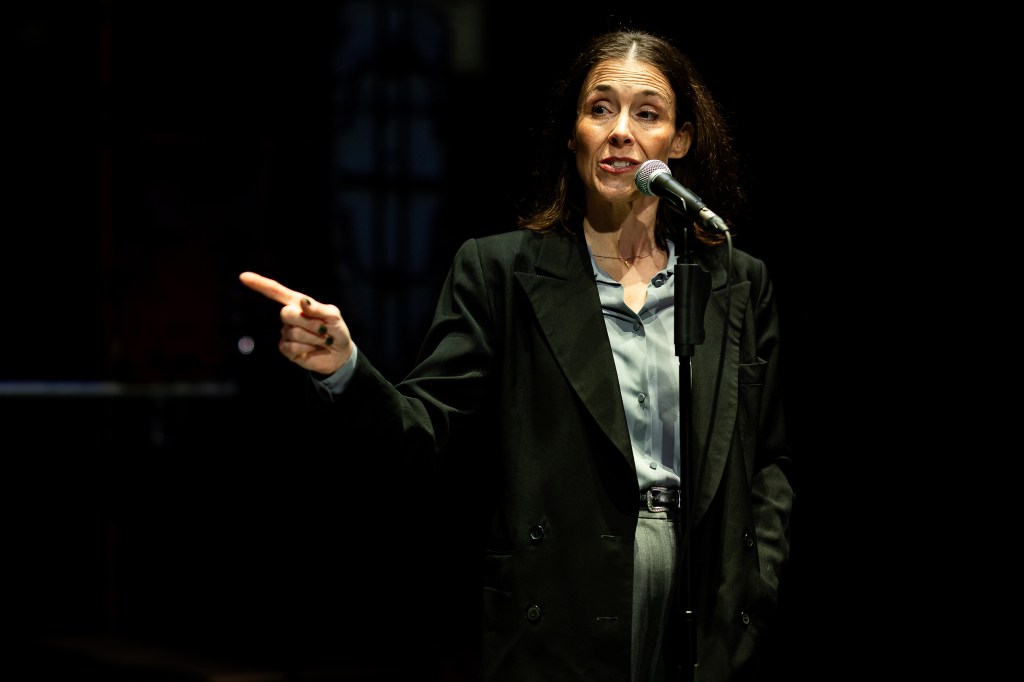
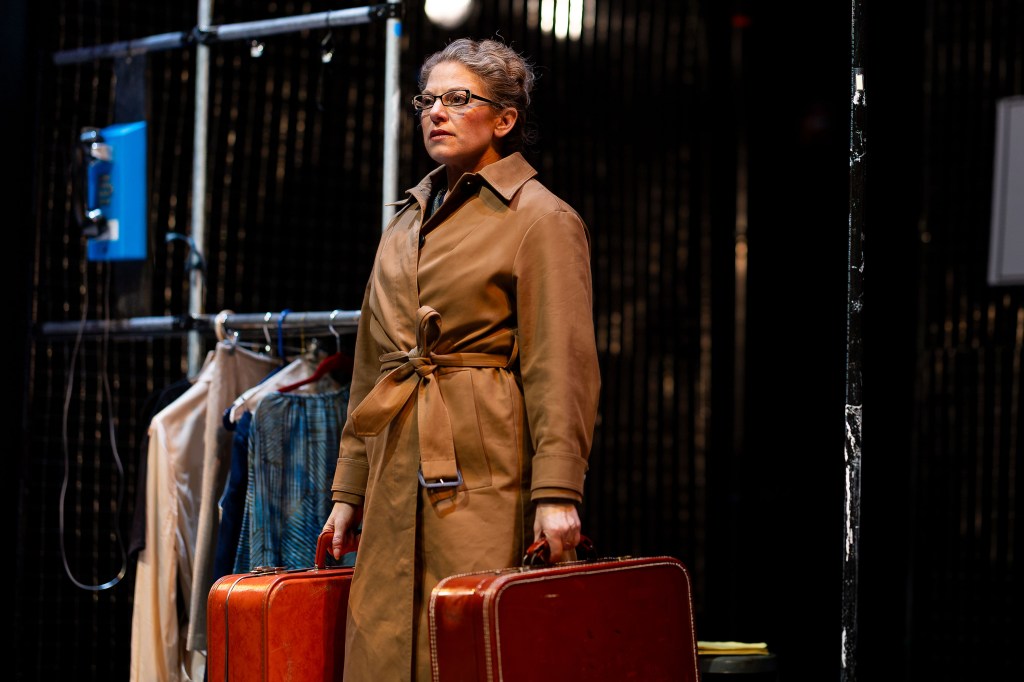
Power and Clare Schroeder, the eldest daughter of the policeman killed in the robbery and the other central character, are superbly played by Rebecca Gilbin and Rachael Warren, two longtime stalwarts at Trinity Rep who artfully guide the audience through the years in question.
Everyone involved in the robbery – including Power’s close friend Susan Saxe, who eluded police for almost five years — was eventually captured except Power, who disappeared and spent 23 years on the FBI’s Most Wanted List before turning herself in. During that time, she built a new life for herself in Eugene, Ore., becoming a well-regarded mother, businesswoman and eventually wife.
Until the play’s final moments, Power and Schroeder will take turns telling their versions of the events portrayed and how they cast a forever shadow on their lives going forward.
Gibel’s Power wrestles with the decision to turn herself in, knowing that in the process it will almost certainly destroy everything she has carefully built, including her family, through the years. But she reasons, she will never be free until she faces up to what she has done. Gibel inhabits Power completely, including the wrenching scenes when she goes to prison and her family becomes estranged.
Warren’s Schroeder, one of nine children raised in the Fidelis Way Housing Project in Brighton, describes the moments when she finds out her father has been shot, his death soon afterwards and the daunting reality of her mother raising nine children alone. Warren nails every aspect of the character, down to a working-class Boston accent that never feels overdone.
Clare herself eventually becomes a police officer, but she and other family members seethe with the way Power is fawned over by the media after turning herself in and receiving a plea-bargained 8–12-year state prison sentence and being released after six years.
Tragedy has made the Schroeder name an iconic one in police circles. Three years after Walter’s death, his brother, Detective John D. Schroeder, was killed while trying to prevent an armed robbery. The current Boston Police Headquarters are located at One Schroeder Plaza.
It’s hard to overstate the ways the production’s design team aids and abets the onstage story. The entire back wall of the stage is covered floor to ceiling with An-Lin Dauber’s set, which contains cubicles of different sizes which contains various pieces of evidence and other true crime artifacts, as well as TV monitors which instantly come to life for clips of events portrayed in the play. Those clips and other vivid video projections are masterfully assembled and displayed by video designer Peter Sasha Hurowitz.
The sound design by DJ Potts and Kaileykielle Hoga hues to the true crime vibe, and the lighting design by Christina Watanable skillfully adapts to the ever-changing times and places portrayed in the story.
It is hard to imagine a new work – especially one already committed to three separate runs — getting off to a better start than this production. It deserved the steady hand of the renowned Columbus, and undoubtedly, it helped that he has worked with both actors many, many times, and is also well acquainted with the playwrights, who already have authored similar docudramas to great acclaim.
After this run ends, the show will be performed Feb. 3-21, 2027, at the Northern Stage in White River Junction, Vt.
“The Getaway Driver” is a tribute to the powers of collaboration by a group of artists at the top of their game and deserves every bit of the attention it has received and then some.
The Central Square Theater presentation of “The Getaway Driver.” Written by Deborah Salem Smith and Charlie Thurston. Directed by Curt Columbus. At The Central Square Theater through Nov. 22. Centralsquaretheater.org
Discover more from onbostonstages
Subscribe to get the latest posts sent to your email.