Many years later, ‘All My Sons’ is still teaching us
By Rich Fahey
BOSTON – At a time in the late 1940’s when Americans basked in the euphoria of winning World War II, everything seemed possible. The American Dream was in full sway.
Still, there was an undercurrent of uneasiness in the country, and playwright Arthur Miller was there to provide a contrarian point of view to the cockeyed optimism that was prevalent. In doing so, he also voiced universal, ageless truths, so the two works in question are as fresh today as the day they opened on Broadway.
“All My Sons” exploded onto the scene in January 1947, based on a true story. Miller followed that up in 1949 with another iconic classic: “Death of a Salesman,” widely regarded as the best American play, which also provided the flip side of the American Dream.
“Death of a Salesman’ has never really left the stage, with Nathan Lane starring in the most recent Broadway production. “All My Sons” has been revisited only sporadically, but this year found it again a huge hit on Broadway after sweeping London’s Olivier Awards.
Now the Lyric Stage Company has crafted a superb production, expertly directed by Scott Edmiston and led by Bill Mootos.
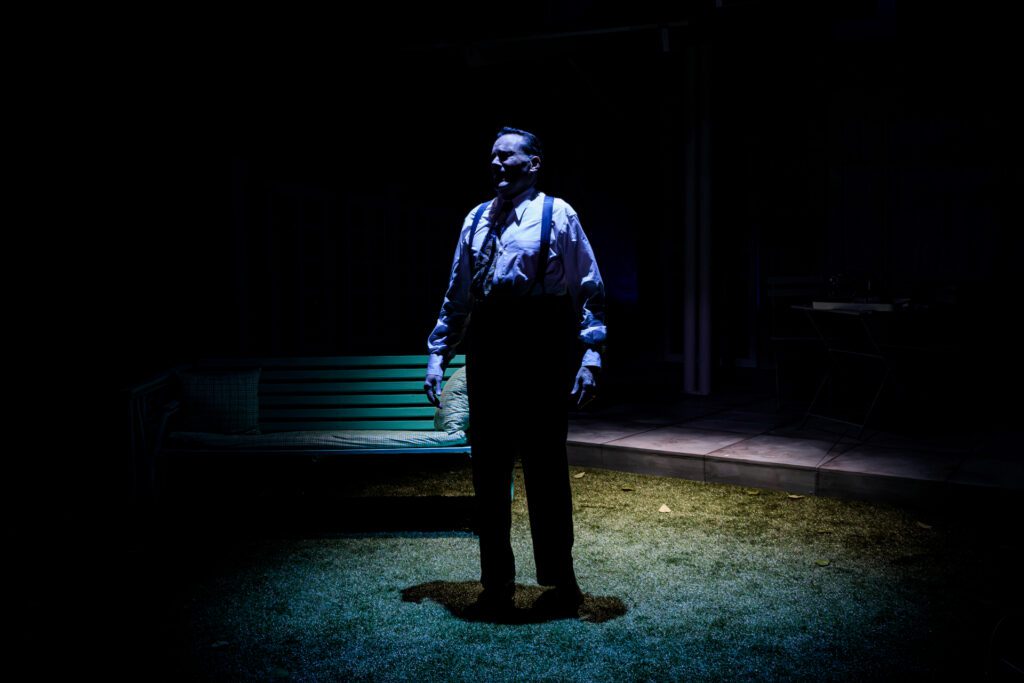
It is late summer1946 in an unnamed quiet Midwestern town. Mootos is Joe Keller, the patriarch of the Keller clan, who has built a successful machine shop business over 40 years, enabling his family to afford an upper-middle-class living that includes a maid.
But behind his smiles, jokes and glad-handing, Joe is a wounded, empty soul. His firm manufactured airplane engine parts during World War II. When a large number of cylinder heads were defective, the firm still sold them to the Army Air Force, and the crashes of the P-40s they were installed in killed 21 pilots. But Joe has somehow beat the rap, leaving neighbor and business partner Steve Deever (unseen) holding the bag and in prison.
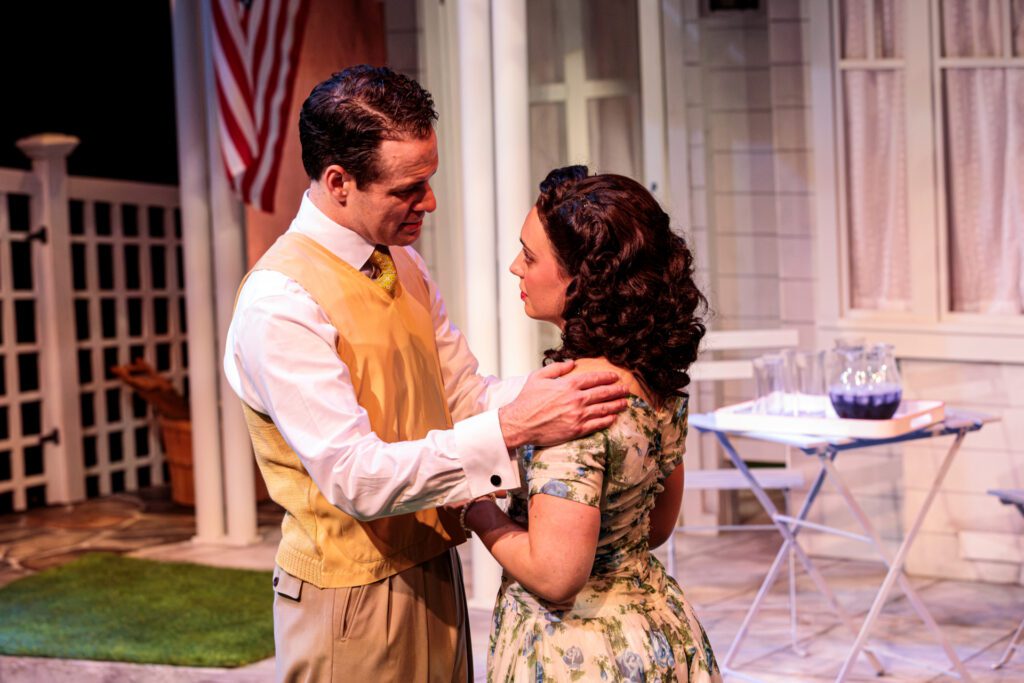
As “All My Sons” opens, Joe’s son Chris (Mark Souza) has decided to propose to Ann Deever (Josephine Moshiri Elwood), Steve’s daughter, who is visiting the Keller home. That shakes the foundations of the family because Ann was the girlfriend of Chris’s airman brother Larry, who was reported missing in action during the war.
Laura Marie Duncan’s Kate Keller is a mother in denial, grasping at straws, including the astrology of Frank Lubey (Eric McGowan) a well-meaning neighbor who tells her Larry is alive. She appears cheery and optimistic, but early in the first act she notes that a tree planted in Larry’s memory has fallen over, an early marker by Miller that a storm is brewing.
She has come to terms with what Joe has done but believes in her heart Larry is alive, because essentially her life is over if he isn’t. And if Ann marries Chris, that also means Larry is really dead and her life is meaningless.
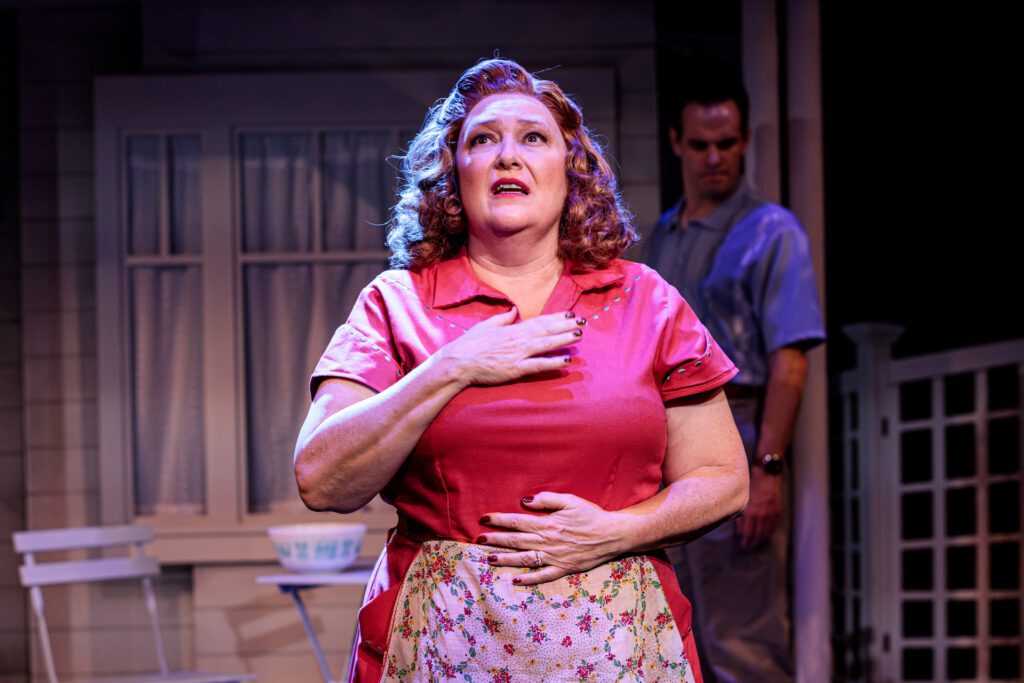
“Everything that happened seems to be coming back,’’ Kate says, in this instance referring to Ann returning but in essence talking about all of the problems of the family returning, all at once.
Chris was also in the war and led a battalion, most of whom never made it home. And he carries that mantle of guilt around as part of his burden, along with being the “surviving son.” He is working for his father – a man he once admired – but in a job he hates, simply surviving and hoping to escape with Ann.
Moshiri Elwood, who was excellent in Lyric Stage’s “Our Town,” depicts Ann as a vulnerable sort who hates her father for what he has done, and early on is solidly in support of Chris and the decision to marry, despite Kate’s opposition.
The neighbors who stop by are pleasant enough, such as Dr. Jim Bayliss (Chris Heiuser) and wife Sue (Allison Beauregard) as well as Kate’s longtime friend Lydia (Cara Clough), but their feelings may be well masked; the entire community carries the stain and feels the disgrace because of what has happened during the war, and they deeply resent it.
Mootos’s Joe is constantly putting forward a version of himself that he hopes will be bought, without anyone noticing the unease that he feels in every passing moment. If he can’t sell himself to his family and friends, what chance does he have?
The constant smiling, glad-handing and joking turn to frowns and concern in the fraught moment when Ann’s brother George (Quinton Kappel) announces he will be visiting the Keller family after seeing his father in prison.
George’s appearance is the very picture of doom for Joe and the Keller family as he patiently lays out what he has learned from his father.
Edmiston’s direction coaxes out the best the cast has to offer and resists the temptation to gild the lily, allowing the tension and dread to build slowly and surely before the harrowing Act III, when a series of devastating revelations in the last 15-20 minutes of the play become a shattering climax that is hard to shake.
The Lyric design team has also taken a less is more attitude to the staging of the work, with Janie E. Howland’s brightly-colored façade of the Keller home, a patch of green, and a white picket fence that combine to suggest a warm welcome awaits. Karen Perlow’s lighting is bright and sunny as the play opens and there are subtle shifts as the tension mounts. Oleg Smirnov’s original compositions and sound design are en pointe, and Chelsea Kerl’s costumes capture the time and place.
Almost 80 years after its debut, Miller’s piece has lessons to teach. All wars – even righteous ones — leave scars, and scars can reopen at any time. Decisions have consequences, and greed and fear can make cowards of us all. When the chickens came home to roost for Joe and the other deeply flawed characters, the American Dream became a nightmare.
The Lyric Stage Company of Boston production of Arthur Miller’s “All My Sons.” Written by Arthur Miller. Directed by Scott Edmiston. At the Lyric Stage Company through Oct. 18. Lyricstage.com.
Discover more from onbostonstages
Subscribe to get the latest posts sent to your email.