Huntington, Sorkin team to re-imagine ‘Mockingbird’
By Rich Fahey
BOSTON – This time, it’s Atticus who may be on trial. And, in Aaron Sorkin’s version, he has questions that have to be answered.
Sorkin (“The West Wing”) dramatically reimagined the role of small-time Southern lawyer Atticus Finch with his stage adaptation of Harper Lee’s iconic novel “To Kill a Mockingbird.” The adaptation, titled “Harper Lee’s To Kill a Mockingbird” debuted on Broadway in December, 2018, after a suit the Lee estate filed against the producers of the adaptation was settled in May 2018
The Sorkin adaptation first came this way in April 2022, when Richard Thomas starred as Atticus in the national touring company’s run at Citizens Bank Opera House.
The Huntington is now debuting its own take on Sorkin’s “Mockingbird,” and Huntington Artistic Director Loretta Greco has added her own touches to the Sorkin adaptation, sharpening the edges even more when it comes to the race-based trial that is at center of the story.
And while Sorkin and, by extension, Greco will ask Atticus some serious questions about his values and the choices he has made — questions neither Lee’s novel nor the 1960 film ever did — the production as a whole retains the powerful themes of the novel and the film.
Using Lee’s words as a template, Sorkin has crafted a piece that is also often genuinely funny – with the humor springing organically from the characters and their relationships.
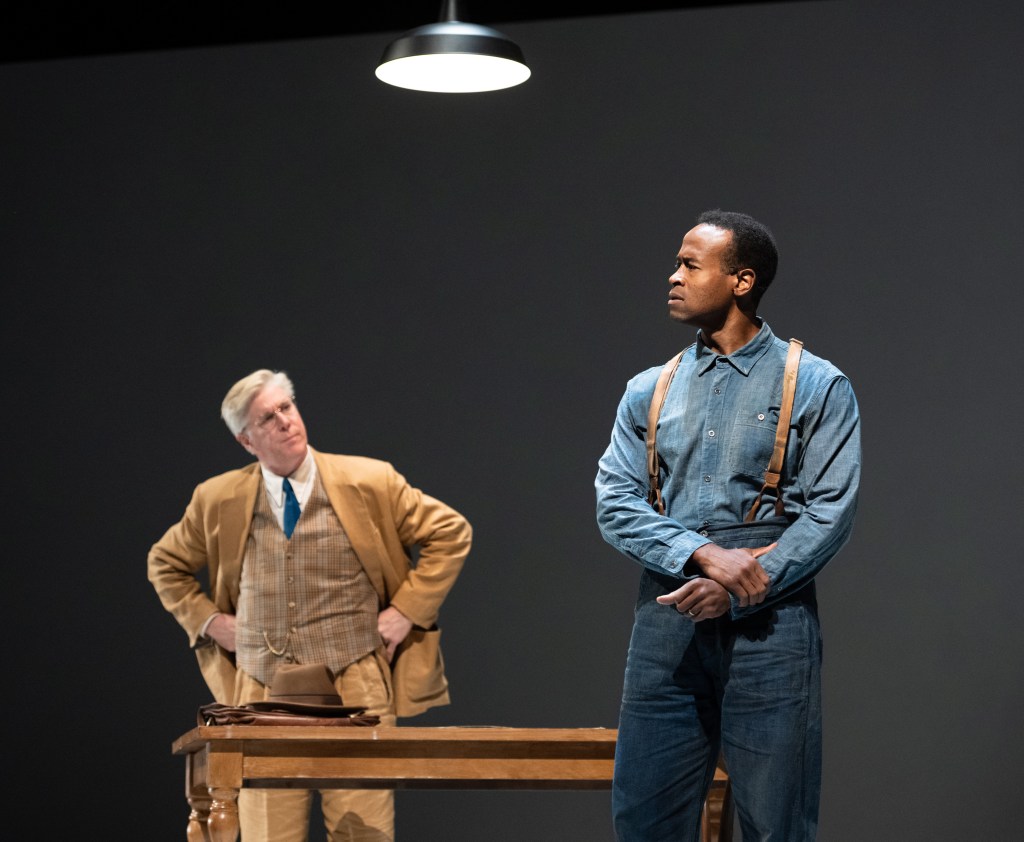
Widower Atticus Finch (Karl Kenzler) is a small-town Southern lawyer in Maycomb, Ala., in Depression-era 1934, and his clients – often poor farmers — sometimes pay him in vegetables. His close friend Judge Taylor (a warm, wonderful Ken Cheeseman) is paying a call to ask if he will defend a black man, Tom Robinson (a superb Rafael Jordan), accused of raping a white woman. Atticus reminds him that his last two criminal clients are no longer with us, but Taylor perseveres and Atticus accepts, knowing there will be blowback but not knowing where it will come from. But the blowback will also allow him to grow and change, and he is a different person by the end.
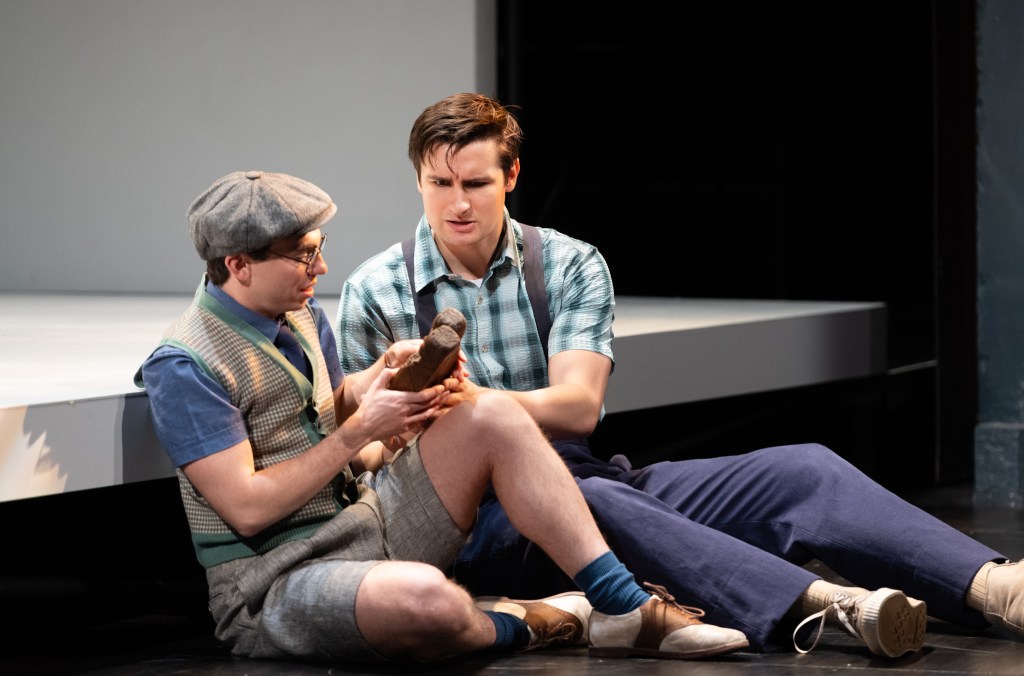
Sorkin made the decision that all three children in the cast would be played by adults. Both Scout Finch (Karen Killeen) and brother Jem Finch (Benjamin Izaak) serve as both narrators and participants, from the opening moments when Scout and Jem debate whether the villainous Bob Ewell (Liam Craig) actually died by accidentally falling on his knife. The third child, Andrew Stevens Purdy as next door neighbor Dill, provides some mild comic relief.
The characters of Calpurnia (Patrice Jean-Baptiste), the Black housekeeper who has been helping Atticus raise his children after his wife’s death, and Robinson have been enlarged in this adaptation. Calpuirnia serves as a counterbalance to Atticus when he talks about finding the goodness in all men and says “I know these people,” asserting they would never send an innocent black man to his death. Jordan’s Robinson is the very picture of decency and dignity even while he is being railroaded for a crime he didn’t commit. The trial is a huge wake-up call for Atticus about his friends and neighbors.
There should be special mention of Ashley Frith, the violinist whose mournful solos (composed with sound designer Daniel Baker) provide just the right touch at crucial moments, or as graceful transitions between scenes.
Greco’s adroit casting means the courtroom scenes lose none of their power. Indeed, they may be even more wrenching in Sorkin’s retelling as he decided to harness the power of the trial and weave it throughout the play as it builds to a shattering climax. Jackie Scholl is superb as Mayella Ewell, the poor young white woman and Tom Robinson’s accuser, as she pours out her resentment at her lot in life before finally melting down when Atticus gently questions her about whether her father, Bob Ewell, ever beat her or abused her.
The evidence – bolstered by Atticus’s interrogation of Bob Ewell — screams Robinson’s innocence but prosecutor Horace Gilmer (Jesse Garlick) grills the defendant relentlessly until he finally answers why he helped Mayella so many times without payment. The words “I felt sorry for her” seal his fate.
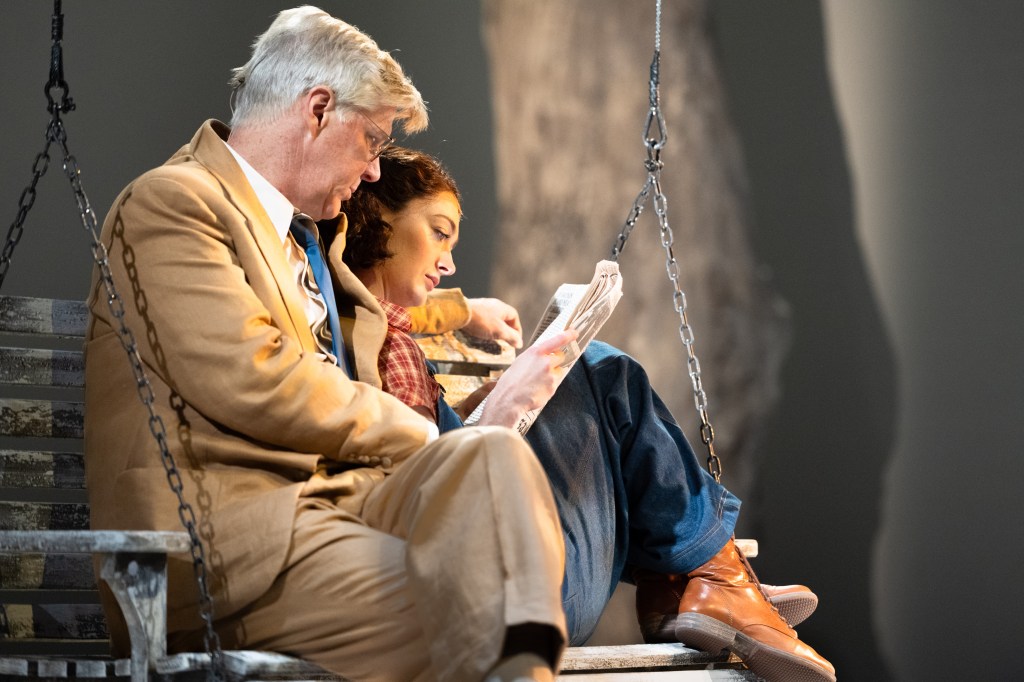
Greco has made some directorial choices to give us a hint where she is going, putting her own stamp on The Huntington production. The scenic design by Andrew Boyce is minimalist, a huge tree towering over the yard with a rope swing at the center of the stage and a screened door that allows the characters to enter and exit the home. It gives the scenes at the Finch home an intimacy and the audience the freedom to focus on the characters and the dialogue, free from what can be the distraction of the dazzling sets that have been part of other Huntington productions.
Greco has also decided to use the wings of the stage and the theater aisles themselves in her staging; it is most effective in the scene where Atticus rushes to the county jail when he hears that Tom Robinson has been unexpectedly moved there, and rumors of a Klan-led lynch mob storming the jail arise.
As Atticus stands onstage guarding the jail, the members of the hooded lynch mob come down the aisles of the theater, gathering at the stage. The appearance of both Jem and Scout, and Scout’s unveiling of a member of the mob as a former client of Attius and the father of a classmate, defuses the situation. But it is another come-to-Jesus moment for Atticus.
Later, the odious Bob Ewell will emerge from the audience and come onstage to confront Atticus. The implication in both scenes is that these characters are indeed in and among us, and we might recognize them as a neighbor or a friend. Jem will question him about that decision not to fight back after a particularly vicious assault by Ewell. Another wake-up call for Atticus. The last and final one will involve both Ewell and the mysterious Boo Radley (Jesse Hinson)
Sorkin early on described adapting “Mockingbird” as a “suicide mission” because of people’ s relationship with both the novel and the 1962 film that starred Gregory Peck in Horton Foote’s Oscar-winning adaptation.
To his credit, he persevered and his adaptation — a satisfying, heartfelt, re-energized and transformed piece — can now stand proudly alongside the novel and the film.
The Huntington production of “Harper Lee’s To Kill a Mockingbird.” Adapted by Aaron Sorkin from Harper Lee’s novel. Directed by Loretta Greco. At the Huntington Theatre, Boston. Through Nov. 8. Tickets start at $29. 617-266-0800, huntingtontheatre.org
Discover more from onbostonstages
Subscribe to get the latest posts sent to your email.