A.R.T.’s ‘Rhinoceros’: Paulus’s last may be first
By Rich Fahey
CAMBRIDGE – When it comes to the Loeb Drama Center, it appears that Diane Paulus may have saved her best for last.
The Tony Award-winning director and American Repertory Theater artistic director is directing her last show at the iconic theater before the A.R.T. moves next May to its new digs in Allston at the Goel Center for Creativity & Performance.
She’s going out with a bang. The theater’s current production of Eugene Ionesco’s absurdist classic “Rhinoceros” is simply superb on all counts.
The first hour of the production – when the endless laughter threatens to bring the play to a standstill — may be the single finest hour of theater I have seen at the Loeb in more than three decades, and that includes such Tony-winning productions as “Porgy and Bess,” “Pippin” and “All the Way.” After intermission, the tone is much different, even harrowing as one by one the residents fall under a collective spell.
The A.R.T. created its own adaptation, working from Derek Prouse’s English translation and its own translation of the original French text. There has been some streamlining, but the end result is a joyous combination of theatrical elements: cast, direction and creatives, all at the top of their game.
“Rhinoceros” takes place in a small, provincial French town in the late 1950’s – Ionesco wrote it in 1959. He was born in Romania but grew up mostly in France and was influenced by both the fascist Iron Guard of his own country and later how the French intellectual left embraced Stalin.
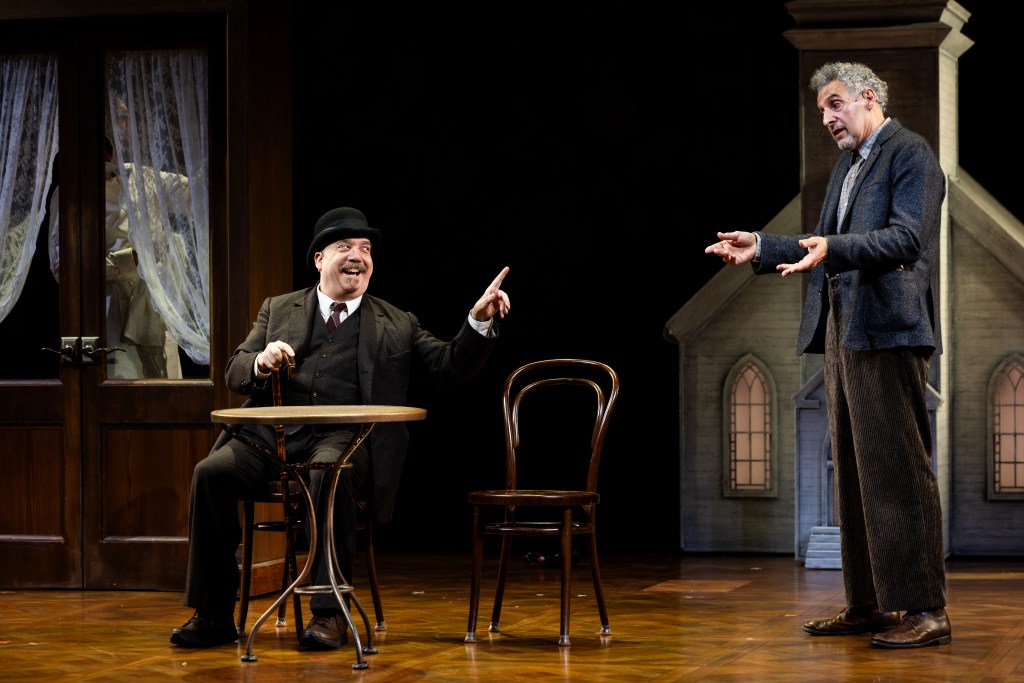
John Turturro heads the cast as Berenger, the flawed, rumpled antihero, a heavy drinker who is questioning if he even exists. He is also, as his longtime friend Jean (Paul Giamatti) notes when they meet at a café on a Sunday morning, perpetually tardy.
Giamatti’s Jean is a self-satisfied intellectual type, free with his criticisms of the hapless Berenger, elevating himself by the moment at the expense of his longtime friend.
Berenger eventually reveals his feelings for his work colleague Daisy (Tatiana Maslany), but worries that the ambitious Dudard (Alex Ross) will box him out. That earns him a lecture from the condescending Jean about discipline and self-improvement.

It’s the little things that elevate the byplay between Turturro and Giamatti into pure comic gold. The piling on by Jean becomes more acute, until the sudden appearance of a rhinoceros into the square – the first of a series of thunderous sound effects that seem to shake the Loeb to its foundation — creates a commotion that can’t be ignored.
When a second rhinoceros tramples a bystander’s cat, it leads to a hilarious shouting match between Jean and Berenger over the number of the animals and what kind they were..
The haplessness of Berenger’s life becomes fully apparent when he shows up – late – to his newspaper office just as his haughty boss, Mr. Papilllon (Peter Francis James), is railing against tardiness. His colleague Daisy – the woman he secretly loves – slips him a time slip so he can avoid the boss’s wrath.
The conversation turns to the rhinoceros reports, and the leftist views of Botard (Clay Singer) throw cold water on the reports, fueled by his hatred of journalists. The ongoing conversation is interrupted by a frantic Mrs. Boeuf (a wonderful Kristine Nielsen) who says her husband is unwell and was being chased by a rhinoceros. Another rhino promptly arrives and destroys the building’s stairs.
Mrs. Boeuf – and everyone else – is horrified at the sight, but soon she recognizes the animal as her husband and descends into the chaos, riding off on her husband’s back, joining the ever-increasing herd. And that’s just Act I.
In Act II, it is time for Giamatti to rise and shine again. Berenger calls on Jean to apologize for the argument the day before and Jean admits to feeling off, a little headache from a bump on his head that will eventually turn into – uh-oh — a horn. Giamatti’s hilarious transformation – aided immeasurably by throat hoarseness and precisely-timed roars from sound designer Fitz Patton – are a tribute to his comic skills and timing
After intermission, it is Turturro’s turn to try and confront the madness as he slowly slips into despair. He is holed up in his apartment when a breathless Botard arrives with news of many more — even firemen – being lost. Then Daisy arrives with a basket of goodies. He and Berenger bob and weave over her affections until Dudard slowly and surely slips away to join the herd. A new life may begin between Daisy and Berenger, but…
This “Rhinoceros” wouldn’t hit as hard or succeed so well if it weren’t for the efforts of the creative team, especially sound designer Patton and special effects designer Markus Murette. When the ponderous pachyderms start storming around the village, the overwhelming pounding, dust, and smoke seem to travel across the stage of the Loeb Drama Center with them, and the faces of the residents are frozen with fear at the ferocity and size of the animals.
Riccardo Hernandez’s spare, stark stage design makes sure not to distract from the onstage happenings, although I’m not quite sure of the symbolism in Act III when it comes to the iron bed frames in Berenger’s bedroom.
The message is there for all to see, and Paulus and the A.R.T. resist the urge to gild the lily. When the herd starts to stampede into totalitarianism, everyone –the animals stampeding and those simply trying to stay out of the way — are in grave danger.
And, god help us if we have to rely on one somewhat strange anti-hero to stand up and say no and save us.
The American Repertory Theater production of “Rhinoceros.” Written by Eugene Ionesco. Translated by Derek Prouse and adapted by the American Repertory Theater. Directed by Diane Paulus. At the Loeb Drama Center through Sept. 27. Americanrepertorytheater.org.
Discover more from onbostonstages
Subscribe to get the latest posts sent to your email.